
Tubesheet and tube plate materials: how to choose and order a heat-exchanger tube plate
A tubesheet, also written tube sheet and called a tube plate or tubeplate, is the thick drilled plate that holds the tube ends in a shell-and-tube heat exchanger and keeps the shell-side and tube-side fluids apart. Its material must resist the more corrosive of the two fluids and suit the tubes it is joined to. Most tube plates are cut from plate (A240, B424, B443, B575). Thick, large or flanged ones come from forgings (A182, B564). Big alloy tube plates are often explosion-clad or weld-overlaid carbon steel instead of solid alloy.
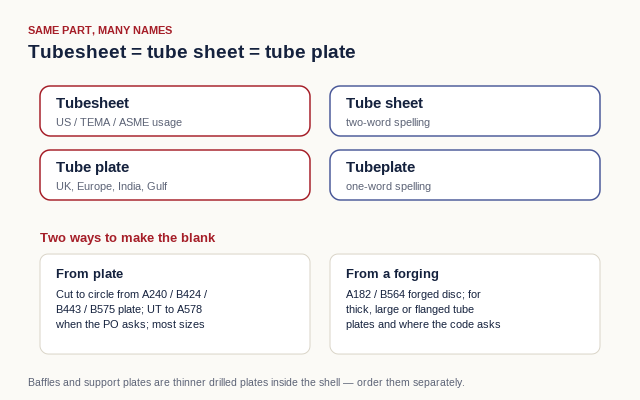
Tubesheet or tube plate — the same part
Drawings from US-based licensors and TEMA-style data sheets say tubesheet or tube sheet. European, British and many Indian and Gulf fabricators say tube plate, sometimes written as one word. They all mean the same component, so we use the names interchangeably on this page. If you search our site for any of them, you will end up at the same plate products.
Do not confuse tube plates with baffles or support plates. Those are thinner drilled plates inside the shell that guide the flow and support the tubes. They are usually ordered separately, often in a lower material, because they see only the shell-side fluid and carry no pressure difference.
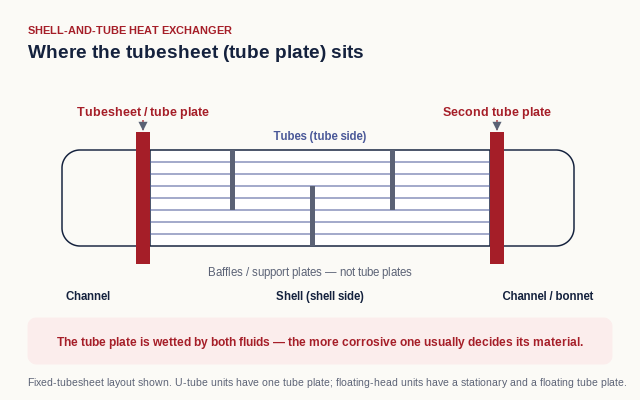
What a tube plate has to do
A tube plate is a pressure part, a corrosion barrier and a machining job all at once:
- Hold pressure from both sides, plus the thermal loads between shell and tubes. Thickness comes from the design code, such as ASME Section VIII Division 1 Part UHX or the TEMA rules. It is calculated, not chosen from a stock list.
- Resist both fluids. The tube-side face sees the channel fluid, the shell-side face the shell fluid, and the drilled holes see both at the tube joint. The more corrosive fluid normally decides the alloy.
- Make a tight tube joint. Tubes are expanded, welded, or both. For expanded joints, the tube should be softer than the tube plate so it seals with residual contact pressure. That is one reason tube and tube plate are usually specified in the same or a closely matched alloy.
- Be sound through the thickness. Laminations in the plate open up when holes are drilled. That is why ultrasonic examination is often specified for thick tube plates.
Choosing the tube plate material
| Service (governing fluid) | Typical tube plate material | Our product page |
|---|---|---|
| Cooling water, general refinery duty | 316L or duplex 2205 | 2205 plate |
| Seawater-cooled exchangers, offshore, desalination | Super duplex 2507 / S32760 (or other seawater alloys) | 2507 plate · S32760 plate |
| Sulphuric and phosphoric acid coolers, fertilizer plants | SS 904L, or Alloy 825 as conditions rise | 904L plate · 825 plate |
| Sour gas and process gas coolers | Alloy 825 or 625, within ISO 15156 limits | 825 plate · 625 plate |
| Hot acid chlorides, chlorination, scrubbers | Hastelloy C276 or C22 | C276 plate · C22 plate |
| Carbon-steel shell side with alloy tube side | Carbon steel clad with the tube-side alloy | Clad plate |
For the alloy decision itself, these comparisons go further: 904L vs 825 vs Alloy 20 for acid service, S32760 vs S32750 for seawater, Inconel 625 vs 825 and Hastelloy C22 vs C276. Titanium and copper-nickel are also used for seawater tube plates. Those are outside our range, so we mention them only so the list is complete.
From plate or from a forging?
| Tube plate cut from plate | Tube plate from a forging | |
|---|---|---|
| Material specs | A240 (stainless, duplex) · B424 · B443 · B575 | A182 (stainless, duplex) · B564 (nickel alloys) |
| Typical use | Most sizes and thicknesses; fixed and U-tube units | Very thick or large tube plates, and integral flanged or hubbed designs |
| Soundness check | UT to ASTM A578 when specified | UT to the forging specification or the PO |
| Cost | Usually lower | Higher, but less machining on complex shapes |
Some tube plates also act as flanges. An extended tube plate is bolted between the shell and channel flanges, so the bolt-hole drilling and the gasket faces must follow the same flange standard as the mating flanges. Tell us if that applies, so the blank includes enough outside diameter.
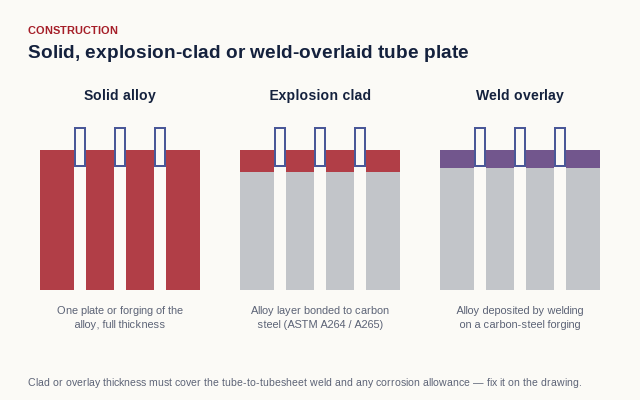
Solid alloy or clad tube plate?
A thick tube plate in solid 904L, 825 or C276 is a lot of expensive alloy. Most of it only carries load. The usual alternative is a carbon-steel backing, typically SA-516 Gr 70, carrying a corrosion-resistant layer on the wetted face. That layer is applied one of two ways:
- Explosion-clad plate to ASTM A264 (stainless) or A265 (nickel alloys), bonded at the mill. See clad plate, including 904L clad and 825 clad; C276- and C22-clad plate is quoted on request.
- Weld overlay deposited on a carbon-steel forging, which is common on hubbed or very thick tube plates.
Either way, the cladding thickness must cover the tube-to-tubesheet weld, any grooves and the corrosion allowance. That figure goes on the drawing, not in the email thread.
Ordering checklist for tube plate blanks
- 01Material: specification, grade and UNS number, for example “ASTM A240 UNS N08904” or “ASTM B424 UNS N08825”.
- 02Route: plate or forging, solid or clad (cladding and backing grades, minimum cladding thickness).
- 03Size: finished diameter and thickness plus machining allowance, or the drawing.
- 04Tests: UT (for plate, A578 with the acceptance level), intergranular corrosion testing, PMI and impact testing where the code asks for it.
- 05Condition and paperwork: heat-treatment condition, EN 10204 3.1 or 3.2, and heat-number transfer to every blank.
We supply tube plate blanks as circles cut from plate, and as forged discs, to your drawing, with heat-number marking. If you need drilling or machining included, say so in the enquiry and we will confirm what can be done for your size. Use the weight calculator for a quick estimate of blank weight.
Tubes to match the tube plate
Ordering the tubes and tube plates together keeps the alloy, condition and certification consistent. Typical tube specifications are ASTM B163 for nickel-alloy condenser and heat-exchanger tubes such as 825, ASTM A789 for duplex and super duplex, B622 for C276 and C22, and A213 for many stainless and alloy-steel exchanger tubes. See our round tube range.
Tube plates for GCC projects
Fertilizer, refinery, petrochemical and desalination plants in Saudi Arabia, the UAE, Qatar and Oman are steady users of 904L, 825, duplex and C276 tube plates. We pack blanks to protect the faces from damage in transit and ship with the certificates your inspection agency asks for.