
Hastelloy C22 vs C276: which C-alloy fits your process?
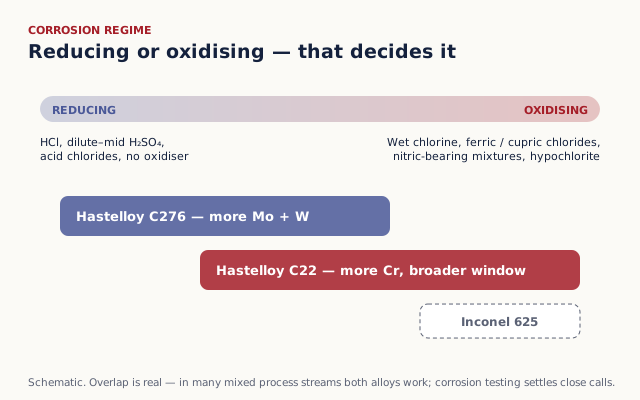
Choose Hastelloy C276 (UNS N10276) for reducing conditions: hydrochloric acid, dilute to mid-strength sulphuric acid and acid chlorides without oxidisers. It has more molybdenum and tungsten. Choose Hastelloy C22 (UNS N06022) when the process is oxidising or swings between the two: wet chlorine, ferric or cupric chlorides, nitric-bearing mixtures. It has more chromium and better stability during welding. For multipurpose plants, C22 is often the safer single choice.
Two generations of the same idea
Both are nickel–chromium–molybdenum alloys with tungsten, made to very low carbon and silicon so they can be used as-welded. C276 came first and became the default “C-alloy” in chemical plants, scrubbers and pickling lines. C22 followed about twenty years later. Its makers rebalanced the chemistry towards chromium to widen the range of conditions it could handle, especially oxidising ones, and improved its resistance to precipitation in the heat-affected zone.
“Hastelloy” is a Haynes International trade name. Generic designations, Alloy C-276 (W.Nr 2.4819) and Alloy C22 (W.Nr 2.4602), are made by several mills. Order by UNS number and ASTM specification, and the trade name becomes irrelevant. Our grade guides for Hastelloy C22 and Hastelloy C276 give the full background on each.
Corrosion behaviour
| Environment | Usually better | Comment |
|---|---|---|
| Hydrochloric acid, no oxidisers | C276 | More molybdenum and tungsten. For very aggressive pure HCl, Ni-Mo B-type alloys are a further step. |
| Dilute to mid-strength sulphuric acid | C276, close with C22 | Contamination tips it: oxidisers favour C22, chlorides favour C276. |
| Wet chlorine, hypochlorite, chlorine dioxide | C22 | Higher chromium holds the passive film in oxidising chloride media. |
| Ferric and cupric chlorides, oxidising acid chlorides | C22 | This is where the extra chromium earns its keep. |
| Mixed or changing streams (multipurpose reactors) | C22 | Its wider window covers more upsets with one alloy. |
| Flue-gas desulphurisation (FGD) scrubbers | Either | Both have long records; C276 is the traditional choice. |
| Pitting and crevice corrosion in chlorides | Either | Both are far beyond stainless and duplex steels. |
Overlap is real. In many process streams both alloys would work, and the choice comes down to price, availability or plant standardisation. When the case is close, a coupon test in the actual fluid beats any chart.
Welding C22 and C276
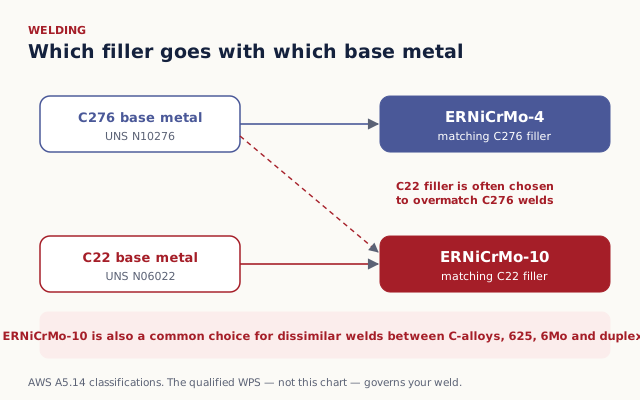
Both alloys weld readily with low heat input and clean practice. Matching fillers are ERNiCrMo-4 for C276 and ERNiCrMo-10 for C22. C22 filler is widely used to weld C276 as well, because the more highly alloyed weld metal tends to resist preferential attack better than the parent metal. The same filler is also a common choice for dissimilar joints between C-alloys, 625, 6Mo stainless and duplex. Your qualified WPS decides, but it is worth asking the fabricator which filler they intend to use.
Standards for each form
| Product form | Hastelloy C276 (N10276) | Hastelloy C22 (N06022) |
|---|---|---|
| Plate, sheet, strip | ASTM B575 | ASTM B575 |
| Seamless pipe & tube | ASTM B622 | ASTM B622 |
| Welded pipe / welded tube | ASTM B619 / B626 | ASTM B619 / B626 |
| Bar | ASTM B574 | ASTM B574 |
| Buttweld fittings | ASTM B366 WPHC276 | ASTM B366 WPHC22 |
| Flanges & forgings | ASTM B564 N10276 | ASTM B564 N06022 |
The specifications are shared, so the UNS number on the PO, the marking and the certificate is the only thing that separates the two alloys on paper.
Flanges, PMI and the MTC
A C22 flange and a C276 flange look identical, and both are forged to ASTM B564. Mix-ups therefore happen at the warehouse, not the mill. Three habits prevent them:
- Read the stamp and the certificate together. The UNS number, heat number and size on the flange must match the EN 10204 3.1 certificate line for line.
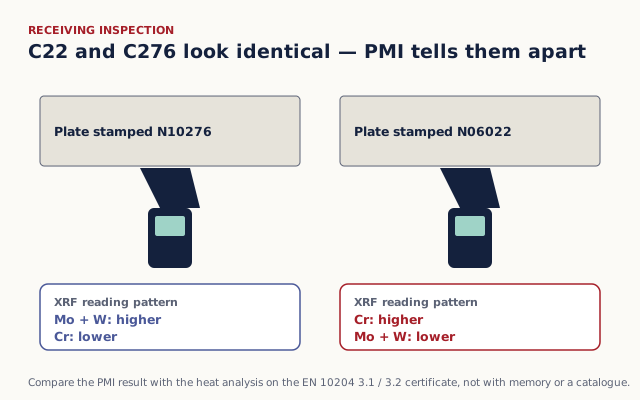
- Run PMI at receipt. A handheld XRF reading separates the two quickly: C22 shows clearly higher chromium, while C276 shows more molybdenum and tungsten. Compare the reading with the certificate, not with a catalogue.
- Check what the MTC actually certifies. Look for the heat analysis, mechanical tests, the solution-annealing condition and any corrosion test your specification asks for. If a witness is required, ask for 3.2. See EN 10204 3.1 vs 3.2 and our quality and testing page.
Product pages: Hastelloy C22 flanges · Hastelloy C276 flanges · C22 fittings · C276 fasteners.
Hastelloy vs Inconel: a quick orientation
Buyers often search for “Hastelloy vs Inconel” as if it were one choice. Both names are brands that cover families of alloys. The useful comparison is grade against grade:
- Inconel 625 is also a Ni-Cr-Mo alloy, with less molybdenum than the C-alloys and with niobium for strength. It is stronger and better at high temperature, but behind C276 in reducing acids. See C276 vs 625.
- Inconel 825 is a nickel-iron alloy for sulphuric and phosphoric acid at moderate conditions, and much cheaper. See 625 vs 825.
- Price: the C-alloys usually cost more per kilogram than 625 and 825, because of their molybdenum and tungsten content. Check a current quotation for your form.
Tube plates and clad construction
Exchangers in chlorination, pickling-acid and scrubber service often use C-alloy tubes. Their tube plates are cut from C276 plate or C22 plate, or — for heavy sections — made from carbon steel clad with C276 or C22, which cuts the cost of a thick solid alloy plate dramatically.
A simple rule
- Reducing acid, no oxidisers: C276.
- Oxidising chlorides, wet chlorine, changing feeds: C22.
- Strength or high temperature as well: look at 625.
- Moderate sulphuric or phosphoric acid without chlorides: 825 or 904L may be enough. See the acid-service guide.
- Not sure: send the process conditions and we will tell you which alloy we would quote, and why.