
Hastelloy C276 vs Inconel 625: which one for your service?
Choose Hastelloy C276 when the problem is aggressive chemistry — hydrochloric or sulphuric acid, wet chlorine, hypochlorite or mixed acids with chlorides. Choose Inconel 625 when you need corrosion resistance and strength or high temperature — seawater, offshore, bellows, heat exchangers and weld overlay. C276 has more molybdenum and tungsten; 625 has more chromium and niobium.
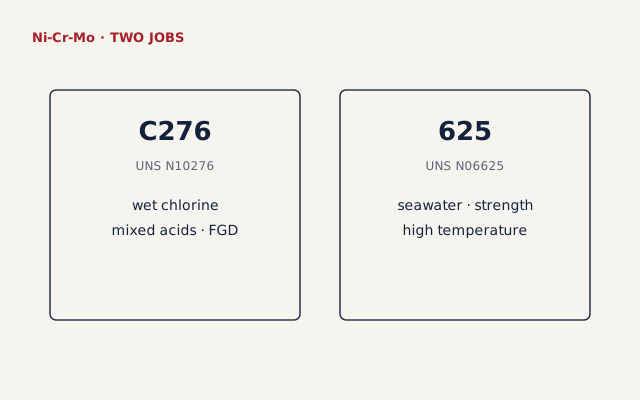
Two Ni-Cr-Mo alloys, two different jobs
Both alloys are nickel–chromium–molybdenum alloys and both appear on the same shortlists, which is why they are so often confused. The difference is in the balance. C276 is built around high molybdenum and tungsten for resistance to reducing acids and localised corrosion. Inconel 625 carries more chromium with less molybdenum and adds niobium, which gives it far higher strength without heat treatment.
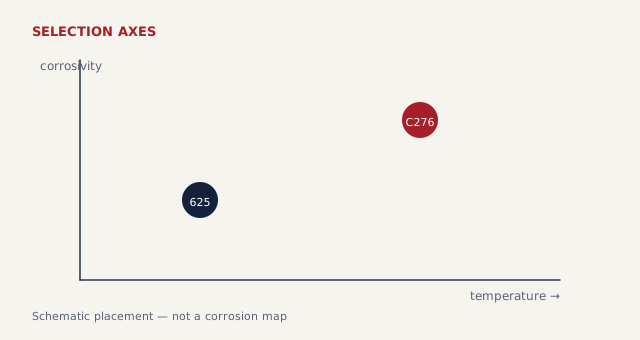
Side by side: composition and pitting resistance
Chemical composition compared
| Element | Hastelloy C276 (N10276) | Inconel 625 (N06625) |
|---|---|---|
| Nickel | Balance | As specified |
| Chromium | As specified | As specified |
| Molybdenum | As specified | As specified |
| Tungsten | As specified | — |
| Niobium + tantalum | — | As specified |
| Iron | As specified | As specified |
| Carbon | As specified | As specified |
| PREN (approx.) | ≈ 68 | ≈ 51 |
Under technical review for TDS. Numerical specification requirements are published only after the applicable current standard edition has been verified.
Governing specifications: ASTM B575 (C276) and ASTM B443 (625). PREN = Cr + 3.3 Mo + 16 N; for nickel alloys it is only a rough guide.
Corrosion resistance
Reducing acids. In hydrochloric and sulphuric acid, the extra molybdenum and tungsten put C276 clearly ahead. It is one of the few alloys used in hot, contaminated sulphuric acid and in flue-gas desulphurisation scrubbers where chlorides and acid condensate meet.
Oxidising media. C276 is also known for resisting wet chlorine gas, hypochlorite and chlorine dioxide — which is why it is standard in bleach plants and chlorination systems.
Seawater and chlorides. Both alloys are effectively immune to pitting and crevice corrosion in seawater at ambient temperature. Inconel 625 is chosen more often in marine work because it adds strength and fatigue resistance.
After welding. The very low carbon in C276 limits grain-boundary precipitation in the heat-affected zone, so it can generally be used as-welded in most chemical service.
Strength and temperature
| Minimum property | C276 (solution-annealed) | 625 (Grade 1 annealed) |
|---|---|---|
| Tensile strength | As specified | As specified |
| Yield strength 0.2% | As specified | As specified |
| Elongation | As specified | As specified |
| Density | 8.89 g/cm³ | 8.44 g/cm³ |
Under technical review for TDS. Numerical specification requirements are published only after the applicable current standard edition has been verified.
Inconel 625 has a higher yield strength than C276 in the annealed condition. That allows thinner walls for the same pressure — a real saving at nickel-alloy prices — and makes 625 the choice for bellows, expansion joints, risers and fasteners.
625 also keeps its strength and oxidation resistance at high temperature and is widely used in the 600–980 °C range. C276 is usually limited to lower temperatures because long exposure in the intermediate range can precipitate phases that reduce toughness and corrosion resistance.
Standards for each product
Cost and availability
C276 usually costs more per kilogram because of its molybdenum and tungsten content, and it is denser, so the same plate weighs about 5% more. Inconel 625's higher strength can offset its price where thinner sections are allowed. Both are stocked in plate, sheet, pipe, fittings and flanges, though large or heavy-wall items may need mill lead time — check before fixing a delivery date.
A simple rule for choosing
- Hot or contaminated sulphuric or hydrochloric acid, wet chlorine, hypochlorite, FGD scrubbers: C276 (or C22 for oxidising mixtures).
- Seawater with load, pressure or fatigue: Inconel 625.
- Service above about 600 °C: Inconel 625.
- Weld overlay or cladding on carbon steel: 625 is the usual overlay; C276 where the process side is strongly acidic.
- Not sure: send the process conditions — medium, concentration, temperature, chlorides — and we will tell you which alloy the conditions need.