
2B vs BA vs No.4: stainless steel sheet finishes explained
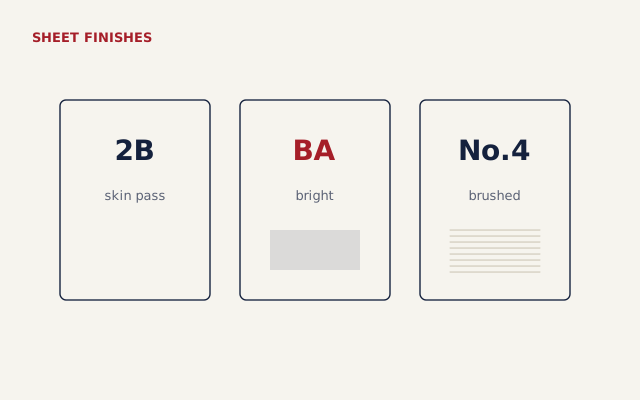
2B is the standard cold-rolled, annealed, pickled and lightly skin-passed finish — order it when the drawing does not say otherwise. BA (bright annealed, 2R in EN 10088-2) is highly reflective because it is annealed in a protective atmosphere instead of being pickled. No.4 is a brushed, directional finish polished with abrasives. Finish is set at the mill, so name it on the order.
How mill finishes are made
Every stainless sheet finish starts the same way: the coil is rolled, then annealed to restore ductility, and the oxide scale from annealing is removed. The route after that sets the surface. Hot-rolled material that is annealed and pickled is No.1 — rough and dull, used on heavier gauges and plate. Cold-rolled material that is annealed and pickled is 2D, a uniform matt grey. Give 2D a light pass through polished rolls and it becomes 2B, smoother and moderately reflective.
BA skips pickling altogether: the strip is annealed in a protective (hydrogen-rich) atmosphere so no scale forms, and the bright cold-rolled surface survives. Polished finishes — No.4, hairline and No.8 mirror — are applied after the mill finish with abrasive belts or buffing.
The finish designations come from the general-requirements standard: ASTM A480 for stainless and duplex flat products, and EN 10088-2 in Europe (where 2B is still 2B, BA is 2R and No.4 is roughly 2J/2K).
The finishes side by side
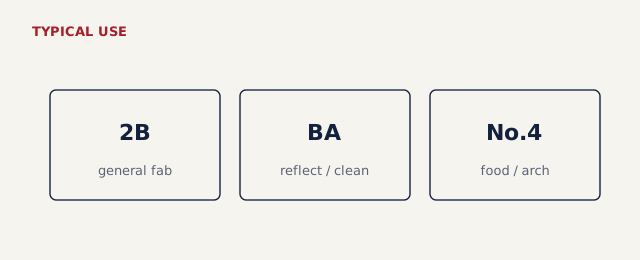
| Finish | How it is made | Look | Typical use |
|---|---|---|---|
| No.1 | Hot rolled, annealed, pickled | Rough, dull | Heavy sheet and plate, industrial equipment |
| 2D | Cold rolled, annealed, pickled | Uniform matt grey | Deep drawing; painted or hidden parts |
| 2B | 2D + light skin pass on polished rolls | Smooth, moderately reflective | General purpose — the default |
| BA (2R) | Bright annealed in a protective atmosphere | Bright, highly reflective | Reflectors, appliances, hygienic and decorative surfaces |
| No.4 | Abrasive polished, directional grain | Brushed | Food equipment, panels, architecture |
| Hairline | Long continuous brushed lines | Fine linear grain | Lift and interior panels, trim |
| No.8 | Polished and buffed to a mirror | Mirror | Decorative and reflective parts |
Which finish should you order?
- Nothing specified on the drawing: order 2B. It is the most widely stocked finish and the base for most further processing.
- Deep drawing or pressing: 2D holds lubricant better than 2B and is less prone to galling in the die.
- Visible and needs to stay clean: BA or No.4. BA shows fingerprints and scratches; No.4 hides handling marks.
- Hygienic or food contact: 2B or BA for vessels and equipment, often specified with a roughness limit (Ra) rather than a finish name.
- Will be painted, lined or insulated: 2D or 2B — paying for a polished finish is wasted.
For bright and polished finishes, ask for PVC protective film, and laser-grade film if the sheet will be laser cut.
Does finish change corrosion resistance?
For the same grade, a smoother surface generally performs better in chloride service because there are fewer sites where deposits and crevices can start pitting. BA and fine polished finishes are therefore preferred in hygienic and coastal service. But finish cannot make up for the wrong grade: if 304 pits in your environment, a better finish on 304 will only delay it — step up to 316L or 904L.
Finishes on duplex and nickel-alloy sheet
Duplex 2205 sheet is normally supplied 2B or 2D; polished finishes are possible but less commonly stocked. Nickel alloys such as Inconel 825, 625 and Hastelloy C276 are described in words under ASTM B906 and their product specifications — "cold rolled, annealed and descaled" is the usual one, often called "2B equivalent" in the trade, with bright annealed available in some thin gauges.