If you are buying Alloy 825 sheet or plate, the material name alone is not enough for a technically complete enquiry.
A clear procurement specification normally identifies the alloy, UNS designation, product form, applicable material specification, dimensions, condition or finish where required, quantity, testing and documentation requirements.
For Alloy 825, buyers commonly encounter the terms Alloy 825, INCOLOY® Alloy 825, Incoloy 825 and “Inconel 825” in supplier listings and searches. The formal material identification used by Special Metals is INCOLOY® Alloy 825, UNS N08825, W.Nr. 2.4858. For rolled sheet, plate and strip, ASTM B424 is the key product specification, with ASME SB-424 used where the ASME designation is required.
This guide explains how those terms fit together and what to put on an RFQ for Alloy 825 sheet or plate.
Quick answer: What specification applies to Alloy 825 sheet and plate?
For Alloy 825 / UNS N08825 sheet and plate, the principal material specification is:
| Procurement item | Typical identification |
|---|---|
| Alloy | Alloy 825 / INCOLOY® Alloy 825 |
| UNS | N08825 |
| Werkstoff | 2.4858 |
| Product forms | Sheet, plate, strip |
| ASTM material specification | ASTM B424 |
| ASME designation | ASME SB-424 |
| Product family | Nickel-iron-chromium-molybdenum-copper alloy |
| RFQ requirement | Alloy + UNS + form + specification + dimensions + condition/finish + testing/documentation as required |
ASTM B424 covers rolled nickel-iron-chromium-molybdenum-copper alloys including UNS N08825 in plate, sheet and strip form.
The important point is that ASTM B424 identifies the material/product specification; it does not by itself define every dimensional or procurement requirement for your order.
Standards note: ASTM B424-22 is the edition referenced in this guide; buyers should confirm the edition and contractual requirements applicable to their project or purchase order.
What is Alloy 825?
Alloy 825 is a nickel-iron-chromium alloy with additions including molybdenum, copper and titanium.
It is commonly selected for applications where resistance to a combination of corrosive environments is important. Special Metals identifies INCOLOY® Alloy 825 as UNS N08825 / W.Nr. 2.4858 and describes its resistance to a range of reducing and oxidizing environments, including sulfuric and phosphoric acid environments.
The alloy is used in applications across chemical processing, petrochemical processing, oil and gas, pollution control, waste processing and other demanding environments.
However, the correct procurement approach is not simply:
“We need Incoloy 825.”
A better specification identifies exactly what form and standard are required.
For example:
Alloy 825 / UNS N08825 plate to ASTM B424
is substantially clearer than:
Incoloy 825 plate
Alloy 825 vs Incoloy 825 vs “Inconel 825”
This is one of the most common sources of confusion when researching or purchasing this material.
INCOLOY® Alloy 825 is the Special Metals designation for this alloy, and its UNS designation is N08825.
At the same time, commercial websites and search results frequently use terms such as:
- Alloy 825
- Incoloy 825
- Incoloy® 825
- Inconel 825
- Inconel 825 sheet
- Inconel 825 plate
- UNS N08825
These terms can appear together in the marketplace even though brand and alloy-family terminology should not be treated as interchangeable without checking the actual material identification.
For procurement, the safest approach is to anchor the enquiry to:
Alloy 825 + UNS N08825 + applicable product specification.
For sheet and plate, that normally means identifying ASTM B424 / ASME SB-424 where applicable.
If a supplier quotation says “Inconel 825,” ask the supplier to confirm the UNS designation and material specification rather than relying on the commercial name alone.
What is ASTM B424?
ASTM B424 is the material specification for nickel-iron-chromium-molybdenum-copper alloy plate, sheet and strip.
The active ASTM listing for B424-22 states that the specification covers rolled nickel-iron-chromium-molybdenum-copper alloys including UNS N08825 in plate, sheet and strip form.
That makes B424 particularly important when specifying Alloy 825 flat products.
What does B424 establish?
The specification addresses requirements associated with the material, including:
- chemical composition
- mechanical properties
- product form covered by the specification
- applicable manufacturing and testing requirements within the standard
The exact requirements should always be checked against the applicable edition and the purchase specification.
This distinction matters because a buyer should not treat ASTM B424 as simply a keyword or quality label.
It is a material/product specification.
ASTM B424 vs ASME SB-424
You will often see Alloy 825 sheet and plate described as:
ASTM B424
and also as:
ASME SB-424
This is why supplier pages may contain both designations.
For procurement, the important thing is to determine which designation your project, engineering specification, pressure-equipment requirement or customer documentation calls for.
A purchase enquiry might therefore state:
Alloy 825 / UNS N08825 plate, ASTM B424.
Or, where the project specifically requires the ASME designation:
Alloy 825 / UNS N08825 plate, ASME SB-424.
Do not assume that adding both designations automatically means the material has been independently certified to every possible code requirement. The applicable project specification and documentation requirements should be confirmed.
Alloy 825 sheet vs Alloy 825 plate
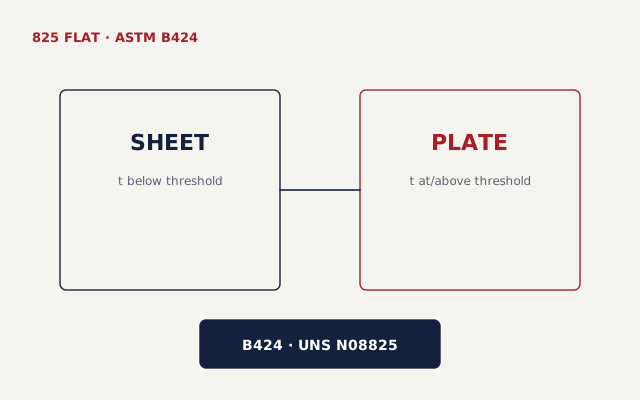
“Sheet” and “plate” are often used interchangeably in online searches, but a purchase specification should identify the required product form and dimensions clearly.
The distinction can affect:
- thickness
- manufacturing route
- dimensional requirements
- finish
- tolerances
- testing
- fabrication requirements
- downstream processing
A supplier may therefore list:
and
as separate products even though both may fall under the same ASTM B424 material specification.
For an RFQ, don't rely on the supplier to infer which form you mean.
State the required form explicitly.
Alloy 825 sheet
An Alloy 825 sheet enquiry should normally identify:
- Alloy 825
- UNS N08825
- ASTM B424 / ASME SB-424 where applicable
- thickness
- width
- length
- quantity
- surface finish where relevant
- delivery condition where relevant
- inspection/testing requirements
- certification/documentation requirements
For example:
Alloy 825 sheet, UNS N08825, ASTM B424, [thickness] × [width] × [length] mm, [quantity], with required material test documentation.
The exact dimensions, tolerances and condition should be established from the applicable specification and purchase requirements rather than copied from a generic supplier table.
Alloy 825 plate
An Alloy 825 plate enquiry follows the same basic principle.
A useful RFQ can state:
Alloy 825 plate, UNS N08825, ASTM B424, [thickness] × [width] × [length] mm, [quantity], required condition, inspection and documentation requirements as applicable.
For larger or project-specific requirements, the buyer may also need to specify:
- drawing or project reference
- dimensional tolerances
- heat treatment condition
- testing requirements
- third-party inspection
- traceability
- marking
- packing
- shipping documentation
- applicable code or customer specification
The more critical the application, the less appropriate it is to leave these requirements implicit.
What does UNS N08825 mean?
UNS N08825 is the Unified Numbering System designation associated with Alloy 825.
This is one of the most useful identifiers to include in an RFQ because it reduces ambiguity between commercial names.
A supplier search may return:
- Alloy 825
- Incoloy 825
- Inconel 825
- N08825
- 2.4858
Using the UNS number gives the buyer another precise material identifier.
For example:
UNS N08825 sheet ASTM B424
is a much more specific procurement phrase than:
825 nickel alloy sheet
W.Nr. 2.4858 and Alloy 825
You may also encounter:
W.Nr. 2.4858
alongside UNS N08825.
Special Metals identifies INCOLOY® Alloy 825 as:
UNS N08825 / W.Nr. 2.4858.
Including both identifiers can be useful when dealing with international specifications or supplier documentation.
However, the identifiers should not replace the actual product specification.
A technically stronger enquiry is:
Alloy 825 / UNS N08825 / W.Nr. 2.4858, sheet, ASTM B424.
rather than simply:
2.4858 sheet.
What information should be on an Alloy 825 sheet RFQ?
A good RFQ should allow the supplier to understand exactly what material and product is required.
Recommended sheet RFQ structure
Material: Alloy 825
UNS: N08825
Product: Sheet
Specification: ASTM B424 / ASME SB-424 as applicable
Thickness: [insert]
Width: [insert]
Length: [insert]
Quantity: [insert]
Condition/finish: [insert if required]
Testing: [insert project requirement]
Documentation: [MTC / inspection documentation as required]
Packing: [insert if required]
Delivery location: [insert]
Incoterm: [insert for export purchase]
This structure is especially useful when purchasing from an international supplier because it separates material identity from commercial logistics.
What information should be on an Alloy 825 plate RFQ?
For plate, use the same basic structure but clearly identify the plate dimensions and project requirements.
Example
Alloy 825 / UNS N08825 plate to ASTM B424, thickness [X] mm × width [X] mm × length [X] mm, quantity [X] MT, required condition [X], with material test documentation and inspection requirements as specified.
For an export enquiry, add:
Delivery: [country/port] | Incoterm: [FOB/CFR/CIF/etc.]
This gives the supplier enough information to quote the material rather than forcing several clarification emails before pricing can be prepared.
Does ASTM B424 define the size you should order?
Not by itself.
This is an important distinction.
A material specification and a purchase requirement are related, but they are not the same thing.
Think of the procurement structure as:
Material
→ Alloy 825 / UNS N08825
Product form
→ Sheet / Plate / Strip
Material specification
→ ASTM B424 / ASME SB-424 as applicable
Dimensions
→ Thickness × Width × Length
Condition / finish
→ As required
Testing / inspection
→ As required by project or purchase order
Documentation
→ As required
This is the same material-to-RFQ logic discussed in our broader Alloy 825 standards guide.
What about chemical composition?
Alloy 825 is a nickel-iron-chromium-molybdenum-copper alloy with titanium additions.
Published composition ranges are available from alloy manufacturers and applicable material specifications.
However, buyers should avoid treating a generic website chemistry table as the controlling acceptance criterion.
For procurement, the applicable edition of ASTM B424 and the actual purchase specification should govern chemical composition and acceptance requirements.
This is particularly important for engineering projects where chemistry, mechanical properties and supplementary testing may be contractually specified.
If your project requires exact chemistry limits, do not copy values from an unrelated supplier page. Reference the applicable standard and verify the material test documentation.
What documentation should you ask for?
Documentation depends on the application and purchase requirements.
For a standard commercial enquiry, buyers may request:
- Material Test Certificate (MTC)
- heat/lot traceability
- chemical analysis
- mechanical test results
- dimensional inspection
- PMI where required
- third-party inspection where required
- certificate of conformity where required
For regulated or critical projects, the documentation package may be considerably more extensive.
If EN 10204 documentation is required, state the required certificate type explicitly rather than simply writing “certificate required.”
Likewise, don't assume that every Alloy 825 order automatically includes PMI, third-party inspection or a particular MTC level. Those requirements should be agreed before order placement.
Alloy 825 sheet and plate for international procurement
Alloy 825 flat products are searched globally using several overlapping commercial terms.
A buyer in the Gulf, South America, Southeast Asia or elsewhere may search for:
- Alloy 825 sheet supplier
- Alloy 825 plate supplier
- Incoloy 825 sheet
- Incoloy 825 plate
- UNS N08825 sheet
- UNS N08825 plate
- ASTM B424 sheet
- ASTM B424 plate
- ASME SB-424 plate
- Alloy 825 plate exporter
- Inconel 825 plate supplier
The terminology varies by market, but the procurement solution should remain technically consistent.
For an export RFQ from India, a buyer may additionally need to specify:
- destination country
- destination port
- Incoterm
- packing requirements
- required documentation
- inspection requirements
- preferred mill/manufacturer requirements
- certificate requirements
For suppliers operating from Mumbai, logistics may also involve export handling through the relevant Mumbai-area port infrastructure. The commercial quotation should state the actual delivery basis rather than assuming a particular freight or port arrangement.
For export enquiries from Mumbai, buyers may also specify the required delivery basis, such as FOB Mumbai/Nhava Sheva where applicable, together with destination, documentation and inspection requirements. This can be particularly useful when sourcing Alloy 825 sheet or plate for projects in the Gulf, South America (including markets such as Brazil, Argentina, Chile, Colombia and Peru) and other international markets. Destination, Incoterms and documentation should be stated in the RFQ rather than assumed from the material designation.
Why “ASTM B424” is an important search term
Many buyers begin with a product query:
Alloy 825 sheet
and only later add the specification:
Alloy 825 sheet ASTM B424
That makes B424 particularly valuable from both an SEO and procurement perspective.
The specification number signals that the buyer has moved beyond general material research toward a more defined purchasing requirement.
However, not every buyer knows the standard number.
That's why a strong Alloy 825 sheet/plate page should serve both audiences:
Buyer who knows the material
“I need Alloy 825 plate.”
Buyer who knows the standard
“I need ASTM B424 plate.”
Buyer who knows the UNS designation
“I need UNS N08825 sheet.”
Buyer using commercial terminology
“I need Incoloy 825 sheet.”
The page should connect these terms without treating them as unrelated materials.
Common mistakes when specifying Alloy 825 sheet and plate
1. Giving only the commercial name
Weak:
Incoloy 825 plate.
Better:
Alloy 825 / UNS N08825 plate to ASTM B424.
2. Giving only the UNS number
Weak:
N08825 sheet.
Better:
Alloy 825 / UNS N08825 sheet, ASTM B424, [dimensions].
3. Confusing material specification with dimensions
ASTM B424 identifies the applicable material/product specification.
It does not mean:
“Any size is automatically acceptable.”
Dimensions, tolerances and purchase requirements still need to be defined.
4. Treating ASME SB-424 as a completely different alloy
SB-424 is the ASME designation encountered for the corresponding material specification.
The buyer should focus on what the project specification actually requires.
5. Assuming every supplier's thickness table is authoritative
Online supplier pages frequently publish their own stock ranges.
Those ranges are commercial availability statements, not necessarily the complete scope of ASTM B424.
Always distinguish:
what the standard covers
from
what a particular supplier currently offers.
6. Using “Inconel 825” without confirming the material
Because “Inconel 825” appears in search results and commercial listings, it can be useful as a search term.
For an actual RFQ, however, confirm:
Alloy 825 / UNS N08825 / applicable specification.
That removes unnecessary ambiguity.
Alloy 825 sheet and plate: buyer's checklist
Before sending an RFQ, confirm:
- Alloy identified as Alloy 825
- UNS N08825 included
- Sheet or plate clearly identified
- ASTM B424 / ASME SB-424 requirement confirmed
- Thickness specified
- Width specified
- Length specified
- Quantity specified
- Condition specified where required
- Finish specified where required
- Testing requirements specified
- MTC/documentation requirements specified
- Third-party inspection requirement specified if applicable
- Delivery location specified
- Incoterm specified for export orders
- Packing/marking requirements specified where required
This simple checklist can eliminate a significant amount of ambiguity before the quotation stage.
Alloy 825 Sheet & Plate vs Other Alloy 825 Products
Alloy 825 is available in multiple product forms, but the applicable specification changes with the product.
For example:
| Product | Common material specification |
|---|---|
| Sheet / Plate / Strip | ASTM B424 |
| Fittings | ASTM B366/B366M |
| Forgings | ASTM B564 |
| Pipe / Tube | Product-specific ASTM specifications |
This is why an RFQ should never simply say:
“Alloy 825 according to ASTM.”
The product form needs to be identified first.
For a broader explanation of how ASTM material specifications and ASME dimensional standards fit together across Alloy 825 products, see our Alloy 825 specifications guide.
Alloy 825 sheet and plate: the practical RFQ formula
For most enquiries, remember this sequence:
**Alloy → UNS → Product Form → Material Specification → Dimensions → Condition → Testing → Documentation → Delivery**
For example:
Alloy 825 → UNS N08825 → Plate → ASTM B424 → 10 × 1500 × 3000 mm → required condition → specified testing → MTC → delivery to [destination].
That is far more useful to a supplier than:
“Quote Incoloy 825 plate.”
Frequently Asked Questions
What ASTM standard is used for Alloy 825 sheet?
ASTM B424 covers rolled nickel-iron-chromium-molybdenum-copper alloy plate, sheet and strip, including UNS N08825.
What ASTM standard is used for Alloy 825 plate?
Alloy 825 plate is covered by ASTM B424 when the product falls within that specification's scope.
What is the ASME equivalent designation for ASTM B424?
The corresponding ASME designation encountered for this material specification is ASME SB-424.
What is the UNS number for Alloy 825?
The UNS designation for Alloy 825 is N08825.
What is the Werkstoff number for Alloy 825?
Alloy 825 is identified as W.Nr. 2.4858 by Special Metals.
Is Incoloy 825 the same as Alloy 825?
“INCOLOY® Alloy 825” is the Special Metals designation. In commercial markets, “Incoloy 825” is widely used as a shortened form. For procurement, confirm the alloy through UNS N08825 and the applicable material specification.
Is “Inconel 825” the official material designation?
“Inconel 825” appears frequently as a commercial/search term, but buyers should not rely on that wording alone. Identify the material as Alloy 825 / UNS N08825 and state the applicable product specification.
What should I include when buying Alloy 825 sheet?
At minimum, identify the alloy, UNS number, product form, applicable specification, dimensions and quantity. Add condition, finish, testing and documentation requirements where applicable.
What should I include when buying Alloy 825 plate?
Specify Alloy 825 / UNS N08825, ASTM B424 where applicable, plate dimensions, quantity and the required testing/documentation and delivery requirements.
Is Alloy 825 strip covered by ASTM B424?
ASTM B424 covers plate, sheet and strip for the alloys within its scope, including UNS N08825. The required product form should be stated explicitly in the purchase specification.
Need an Alloy 825 Sheet or Plate RFQ?
If you are sourcing Alloy 825 sheet or plate, send the required:
material + UNS + product form + ASTM specification + dimensions + quantity + testing/documentation requirements.
For commercial enquiries, see:
- Alloy 825 Sheet — https://kanaksteel.com/inconel/inconel-825/sheet/
- Alloy 825 Plate — https://kanaksteel.com/inconel/inconel-825/plate/
- Alloy 825 Grade Information — https://kanaksteel.com/inconel/inconel-825/
- Alloy 825 Specifications Guide — https://kanaksteel.com/blog/alloy-825-astm-b424-b366-b564/
- RFQ / Enquiry — https://kanaksteel.com/rfq/
For a quotation, include your required dimensions, quantity, destination and documentation requirements so the specification can be reviewed accurately before pricing.