
SA 387 Gr 11 vs Gr 22 vs SA 516 Gr 70: choosing pressure-vessel plate
SA 516 Gr 70 is carbon steel for vessels at moderate and lower temperatures. SA 387 Gr 11 (1¼Cr-½Mo) takes over when the vessel runs hot or in hydrogen. SA 387 Gr 22 (2¼Cr-1Mo) is the step up for higher temperatures and hydrogen partial pressures. Chrome-moly plate costs more and needs controlled welding and PWHT.
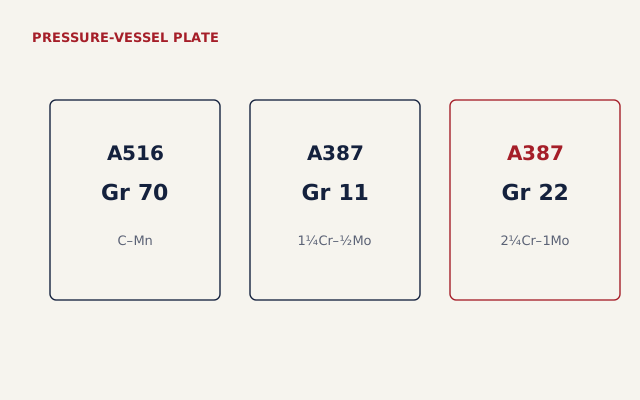
The three plates at a glance
| SA 516 Gr 70 | SA 387 Gr 11 | SA 387 Gr 22 | |
|---|---|---|---|
| Alloy | Carbon–manganese | 1¼Cr-½Mo-Si | 2¼Cr-1Mo |
| Standard | ASTM A516 | ASTM A387 Grade 11 | ASTM A387 Grade 22 |
| Classes | — | Class 1 and Class 2 | Class 1 and Class 2 |
| Typical service | Vessels at moderate and lower temperatures | Hot reactors, drums, exchangers; moderate hydrogen | Higher temperature and hydrogen partial pressure |
| ASME P-No. | P-No. 1 | P-No. 4 | P-No. 5A |
| Matching filler | E7018 / ER70S | E8018-B2 / ER80S-B2 | E9018-B3 / ER90S-B3 |
Why chromium and molybdenum
Carbon steel loses strength and creep resistance as temperature rises, and in hot hydrogen it can suffer high-temperature hydrogen attack. Chromium and molybdenum form stable carbides, which keep strength at temperature and resist that attack. Refinery designers check the operating temperature and hydrogen partial pressure against the API RP 941 (Nelson) curves to decide whether carbon steel, 1¼Cr-½Mo or 2¼Cr-1Mo is needed.
Class 1 vs Class 2
Both Grade 11 and Grade 22 come in two strength classes with the same chemistry. Class 2 is heat treated to a higher tensile and yield range than Class 1 (numerical requirements: under technical review for TDS). The higher class lets designers reduce wall thickness on heavy vessels. See the SA 387 Gr 11 Cl 2 plate page for the full table.
Fabrication: where the cost is
A516 Gr 70 welds with ordinary low-hydrogen practice, with preheat and PWHT set by thickness. Chrome-moly plate needs controlled preheat and interpass temperatures and, in most thicknesses, post-weld heat treatment under ASME VIII (vessels) or B31.3 (piping). Because PWHT can lower strength, buyers order simulated PWHT of the test coupons (ASTM A20 supplementary requirement S3) so the mill certifies properties after the fabricator's heat-treatment cycle. Impact testing (S5) and ultrasonic testing (S8 / S12) are also supplementary — put them on the order.
Matching pipe, fittings and flanges
| Plate | Pipe | Fittings | Flanges |
|---|---|---|---|
| SA 516 Gr 70 | A106 Gr B | A234 WPB | A105 |
| SA 387 Gr 11 | A335 P11 | A234 WP11 | A182 F11 Class 2 |
| SA 387 Gr 22 | A335 P22 | A234 WP22 | A182 F22 Class 3 |