
Duplex 2205 vs super duplex 2507: when is the upgrade worth it?
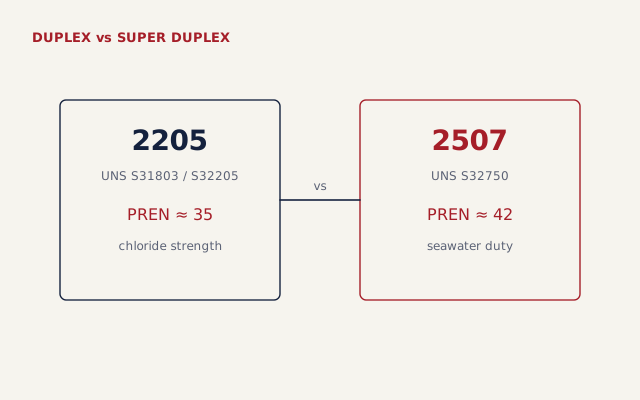
Duplex 2205 (PREN ≈ 35) is the economical choice for chloride-bearing process fluids, brackish water and structures. Super duplex 2507 (PREN ≈ 42) is the standard for seawater, offshore and high-chloride service, with about 20% more yield strength. If the fluid is seawater at ambient temperature or warmer, specify 2507.
What makes a steel "duplex"
Duplex stainless steels have a two-phase microstructure of roughly equal parts austenite and ferrite. The ferrite gives about twice the yield strength of 316L and strong resistance to chloride stress-corrosion cracking; the austenite gives toughness and weldability. Super duplex grades push chromium, molybdenum and nitrogen higher for better pitting resistance.
Side by side: composition and pitting resistance
Chemistry and PREN
| Element | 2205 (S32205) | 2507 (S32750) |
|---|---|---|
| Chromium | As specified | As specified |
| Nickel | As specified | As specified |
| Molybdenum | As specified | As specified |
| Nitrogen | As specified | As specified |
| Carbon | As specified | As specified |
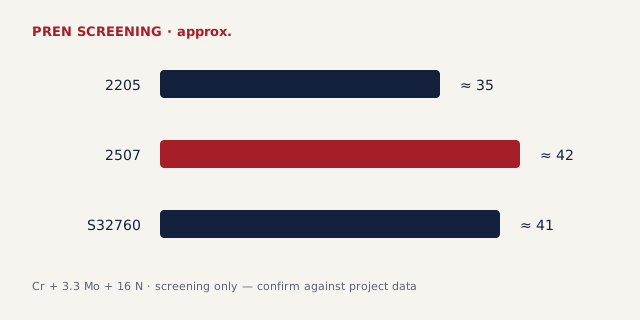
| PREN (approx.) | ≈ 35 | ≈ 42 (≥ 40 usually required by project specifications) |
Under technical review for TDS. Numerical specification requirements are published only after the applicable current standard edition has been verified.
S31803 has wider limits than S32205; most 2205 today is dual-certified to both.
Strength
| Minimum property (plate) | 2205 | 2507 |
|---|---|---|
| Tensile strength | As specified | As specified |
| Yield strength 0.2% | As specified | As specified |
| Elongation | As specified | As specified |
| Hardness | As specified | As specified |
Under technical review for TDS. Numerical specification requirements are published only after the applicable current standard edition has been verified.
Both are much stronger than 316L, which is why duplex often allows thinner pipe walls and lighter structures.
Seawater and chlorides
Pitting and crevice corrosion in seawater are where the two grades part ways. 2205 is widely used in brackish water, cooling water with moderate chlorides and many chemical processes, but in natural seawater it can suffer crevice corrosion under deposits, gaskets and flanges — especially above ambient temperature. 2507, with its higher PREN, is the accepted grade for seawater systems, firewater, desalination and offshore piping. S32760, with copper and tungsten, is the common alternative to 2507.
Temperature limits
Duplex grades are not used for long-term service above about 300 °C, where the ferrite can embrittle ("475 °C embrittlement"). At the low end they keep useful toughness to around −40 to −50 °C, depending on product form and the project's impact-test requirement.
Standards and grade designations
| Product | 2205 | 2507 |
|---|---|---|
| Plate, sheet, coil | ASTM A240 S32205 | ASTM A240 S32750 |
| Pipe | ASTM A790 | ASTM A790 |
| Tube | ASTM A789 | ASTM A789 |
| Buttweld fittings | ASTM A815 WPS32205 | ASTM A815 WPS32750 |
| Flanges | ASTM A182 F51 / F60 | ASTM A182 F53 |
| EN number | 1.4462 | 1.4410 |
The forging designations trip people up: F51 is S31803, F60 is S32205, F53 is S32750 and F55 is S32760.
Welding
Both grades weld well when heat input and interpass temperature are controlled to keep the ferrite–austenite balance. 2205 is welded with 2209 filler; 2507 with 2594 (25-10-4-L). Many projects specify a ferrite range in weld metal and heat-affected zone and ask for impact and corrosion tests in the procedure qualification.
Which one to specify
- Seawater, offshore, firewater, desalination brine: 2507 (or S32760).
- Brackish or cooling water, chemical tankers, pulp and paper, structures: 2205.
- Chloride stress-corrosion cracking was the problem with 316L: 2205 usually solves it.
- Above 300 °C: neither — look at austenitic or nickel alloys.