
S32760 vs S32750: how Zeron 100 and SAF 2507 super duplex really differ
Both are super duplex stainless steels with about half ferrite and half austenite, and both are normally bought to a minimum PREN of 40. S32750 (SAF 2507, flanges A182 F53) reaches that level with chromium, molybdenum and nitrogen. S32760 (Zeron 100, flanges A182 F55) adds tungsten and copper, which project specifications value for erosion and some acid service. In seawater they perform alike. The real choice usually comes down to what the project specification names and what is available in the form you need.
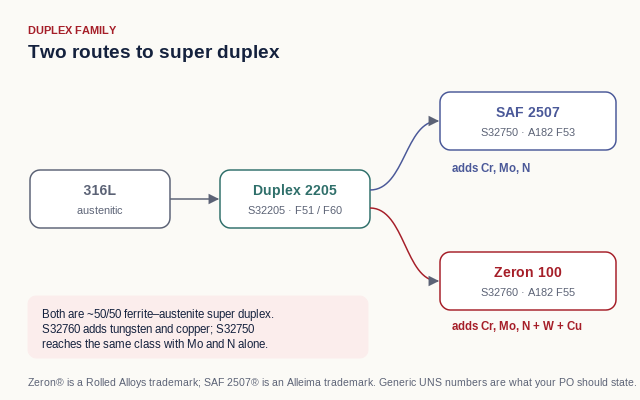
Same class, different recipe
When buyers search “saf 32760” they usually have a mix of two names in their head. SAF 2507 is Alleima’s (formerly Sandvik’s) trade name for UNS S32750, EN 1.4410. Zeron 100 is Rolled Alloys’ trade name for UNS S32760, EN 1.4501. The two grades come from different producers who reached the same class of material by different routes.
Both start from the 25% chromium super duplex concept: higher chromium, molybdenum and nitrogen than duplex 2205, balanced so the steel is roughly half ferrite and half austenite after solution annealing. S32760 then adds controlled amounts of tungsten and copper. Tungsten works much like molybdenum against pitting. Copper helps in some reducing acids and is credited with better erosion-corrosion behaviour. If you are still deciding whether you need super duplex at all, read duplex 2205 vs super duplex 2507 first.
PREN: the number both are bought on
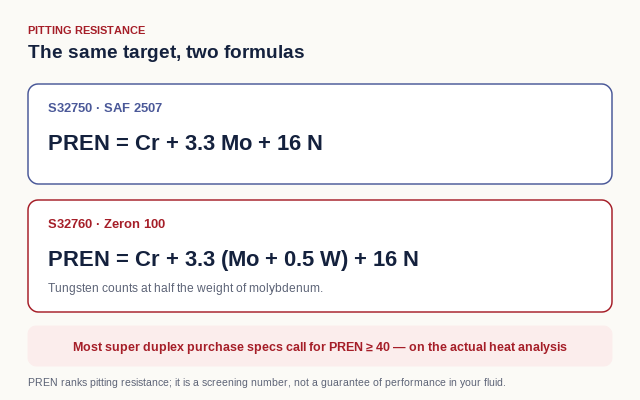
Super duplex is usually specified with a minimum pitting resistance equivalent number. Most project specifications ask for PREN 40 or higher, calculated from the actual heat analysis, not from the nominal grade. The formula differs slightly between the two grades because S32760 contains tungsten:
- S32750: PREN = Cr + 3.3 Mo + 16 N
- S32760: PREN = Cr + 3.3 (Mo + 0.5 W) + 16 N
When you review a mill certificate, check that the PREN was calculated with the right formula and that it meets the minimum on every heat. You can check a heat yourself with our PREN calculator. PREN ranks alloys against pitting, but it does not predict how a weld will behave or how the alloy will fare in a particular fluid.
Where each grade is used
| Application | Common choice | Comment |
|---|---|---|
| Seawater piping, firewater, cooling water | Either | Both are standard super duplex choices. Project specifications in some regions prefer S32760. |
| Instrument tubing and small-bore tube | S32750 more often | S32750 is more widely produced as seamless tube and coil. |
| Pumps, valves, castings | S32760 more often | The cast equivalent of S32760, ASTM A890 Grade 6A, is widely used for pump casings. |
| Flanges, forgings, offshore manifolds | Either — F53 or F55 | Follow the project material data sheet. |
| Desalination: brine, high-pressure lines | Either | Watch crevices under gaskets and deposits. Both grades have a temperature ceiling in seawater. |
| Warm, oxygenated seawater above super duplex limits | Neither | Look at Inconel 625 or 6Mo. 904L is not a warm-seawater alloy. |
Both grades are limited at the top end by the risk of embrittlement during long exposure at intermediate temperatures. Neither is a high-temperature alloy, and the upper limit for pressure parts comes from your design code. At the low end, toughness is shown by impact testing at the temperature your specification calls for.
Standards for each form
| Product form | S32750 (SAF 2507) | S32760 (Zeron 100) |
|---|---|---|
| Plate, sheet, strip | ASTM A240 S32750 | ASTM A240 S32760 |
| Seamless & welded pipe | ASTM A790 S32750 | ASTM A790 S32760 |
| Tube | ASTM A789 S32750 | ASTM A789 S32760 |
| Buttweld fittings | ASTM A815 WPS32750 | ASTM A815 WPS32760 |
| Flanges & forgings | ASTM A182 F53 | ASTM A182 F55 |
| Castings (reference) | ASTM A890 Gr 5A | ASTM A890 Gr 6A |
Dimensions: ASME B16.5 / B16.47 flanges, ASME B16.9 fittings, ASME B36.19 pipe. Many offshore buyers also apply a project or NORSOK-style material data sheet with extra tests; send it with the enquiry.
F55 vs F53 flanges
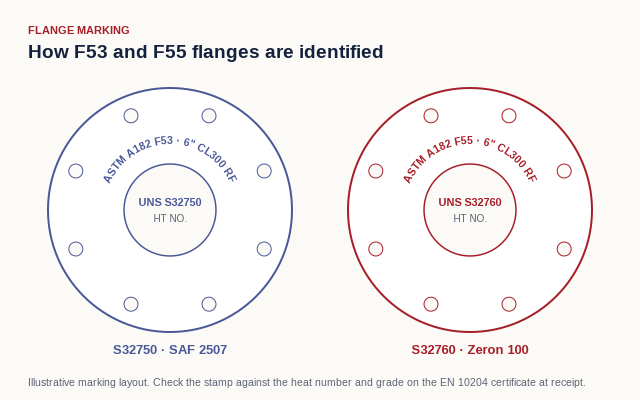
F53 and F55 are the ASTM A182 designations for S32750 and S32760 flanges. They are not interchangeable labels. A flange stamped F53 is S32750, and an F55 is S32760, whatever the supplier’s catalogue calls them. At receipt, check four things:
- The grade stamp matches the heat number and grade on the EN 10204 certificate.
- Solution annealing and quenching are shown on the certificate. Slowly cooled heavy flanges can form intermetallic phases that destroy toughness and corrosion resistance.
- The tests your specification asks for, such as ferrite content, impact energy or a ferric chloride (ASTM G48) test, are on the certificate with acceptance values.
- Weld neck bore matches the pipe schedule. See weld neck vs slip-on and how pressure classes work.
Product pages: S32760 (F55) flanges · super duplex 2507 (F53) flanges · S32760 fittings.
Can one replace the other?
Technically, in most seawater and chloride service, yes, they perform comparably. Commercially, only with written approval. The grade is named in the material data sheet, the design calculations and often the welding procedures. Substituting F53 for F55, or the reverse, is a concession request, not a purchasing decision. If your specification allows “super duplex, PREN 40 minimum” without naming the UNS number, either grade is acceptable, and you can choose on availability and lead time.
Welding deserves the same care with either grade. Use the filler and procedure qualified for the grade, control heat input and interpass temperature, and check the ferrite balance in the weld and heat-affected zone. Most super duplex failures we hear about come from welding, not from the choice of grade.
Tube plates for seawater coolers
Seawater-cooled exchangers are a natural home for super duplex. The tube plates (tubesheets) are cut from 2507 plate or S32760 plate, or made from F53/F55 forgings, with matching A789 tubes. Keeping tubes and tube plate in the same grade avoids galvanic and welding complications.
GCC projects
Across Saudi Arabia, Qatar and the UAE, super duplex is used in offshore topsides, seawater intake and cooling systems, firewater rings and desalination plants. We supply plate, pipe, fittings and F53/F55 flanges to buyers in the Kingdom of Saudi Arabia, Qatar and the UAE. Send the material data sheet with the enquiry, so the quotation covers the extra tests rather than discovering them at inspection.