
Inconel 625 vs Inconel 825: which nickel alloy does your service need?
Pick Inconel 825 (UNS N08825) for sulphuric and phosphoric acid, sour oil-and-gas lines and general chemical duty where moderate strength is enough. It is the cheaper of the two. Pick Inconel 625 (UNS N06625) when the job also needs high strength, resistance to warm seawater and crevices, fatigue resistance or service hotter than 825 is allowed to run. In one line: 825 is the acid alloy, 625 is the strength-and-seawater alloy.
Why these two get confused
On a lot of enquiry sheets the two names sit next to each other, often with the same question underneath: “625 or 825, which is better?” Part of the muddle is the naming. Inconel 625 is a Special Metals trade name for a nickel–chromium–molybdenum alloy. Alloy 825 was sold as Incoloy 825, but most buyers in India and the Gulf now call it Inconel 825, and both names are used for the same UNS N08825 material. If that one has caught you before, our note on Inconel 825 vs Incoloy 825 explains it in two minutes.
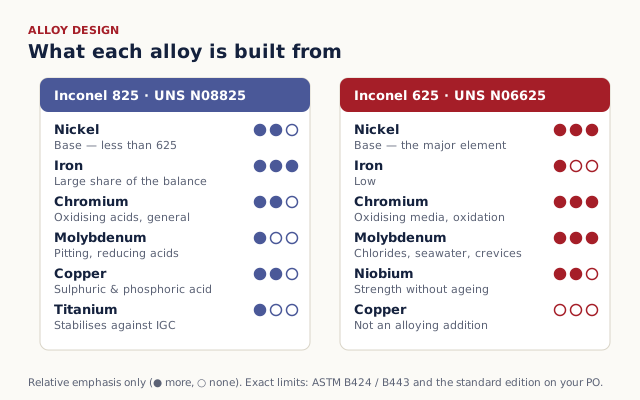
The bigger point is that “better” has no meaning here without the service. The two alloys were designed for different problems, and they are priced differently because of it. 625 is mostly nickel, with high chromium and molybdenum and an addition of niobium. 825 swaps a large share of that nickel for iron, keeps a useful amount of chromium and molybdenum, and adds copper and titanium. Less nickel and no niobium is why 825 costs less. The copper is why it handles sulphuric acid so well.
Corrosion resistance, service by service
The table below is how we would short-list the two for common enquiries. It is a starting point, not a substitute for corrosion data on your actual fluid.
| Service | Usually enough | Why |
|---|---|---|
| Sulphuric acid, phosphoric acid, pickling | 825 | Copper and molybdenum together give 825 its resistance to reducing acids. This was the job it was developed for. |
| Sour oil and gas lines, downhole tubulars | 825, or 625 at higher severity | Both are covered in ISO 15156-3 within listed limits. Check the table for your H₂S, chloride and temperature (NACE MR0175 / ISO 15156). |
| Seawater, brine, warm chlorides, crevices | 625 | 625 has much more molybdenum, so it resists pitting and crevice attack where 825 can start to suffer, especially in warm Gulf seawater. |
| Chloride stress-corrosion cracking | Either | Both carry enough nickel to resist chloride SCC far better than 316L or 904L. |
| High strength, pressure, fatigue, bellows | 625 | Its annealed strength is markedly higher, so walls can be thinner. |
| High temperature, oxidation | 625 | 825 is normally kept below about 540 °C for pressure parts. 625 goes well beyond that. |
| Hot, contaminated mixed acids with chlorides | Neither — look at C276 / C22 | See Hastelloy C22 vs C276. |
Two points are easy to miss. First, 825 is stabilised with titanium, so it is not prone to intergranular attack after welding in most acid service. That is one reason it is popular for welded acid piping. Second, if the acid is moderate and chloride-free, an iron-based super-austenitic like SS 904L may do the job for less money than either nickel alloy. Our 904L vs 825 vs Alloy 20 acid guide covers that decision.
Strength and temperature
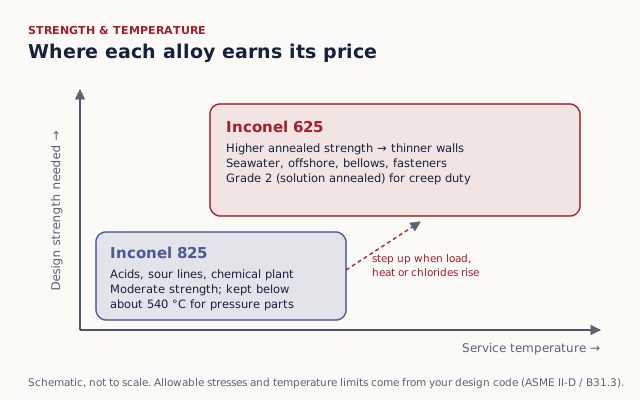
This is where the two alloys part company. In the annealed condition, Inconel 625 has a much higher minimum yield strength than 825. On a pressure design, that higher allowable stress lets the designer use a thinner wall. At nickel-alloy prices the saving can close a good part of the price gap per metre of pipe. The same strength is why 625 is used for bellows, expansion joints, risers and high-load fasteners.
625 plate and sheet to ASTM B443 comes in two grades. Grade 1 is annealed and is the normal choice up to moderate temperatures. Grade 2 is solution annealed and is used where creep strength matters at high temperature. State the grade on the PO. A “625 plate” line with no grade invites the wrong material.
825 is a corrosion alloy first. It is generally kept below about 540 °C in pressure service, and its strength is closer to that of austenitic stainless steel. If the design is pressure-led, with corrosion as a secondary concern, 825 will usually come out heavier than 625.
Standards for each product form
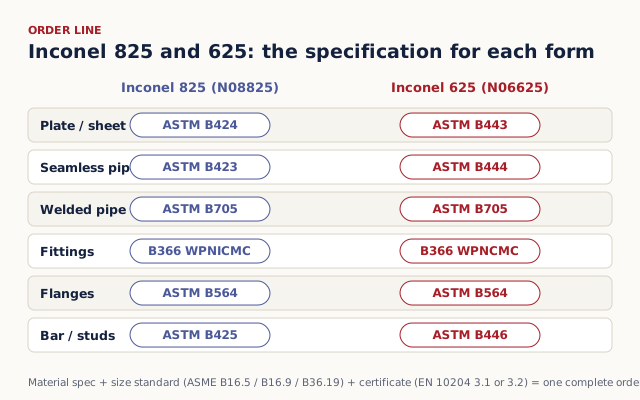
| Product form | Inconel 825 (N08825) | Inconel 625 (N06625) |
|---|---|---|
| Plate, sheet, strip | ASTM B424 | ASTM B443 |
| Seamless pipe & tube | ASTM B423 | ASTM B444 |
| Welded pipe | ASTM B705 | ASTM B705 |
| Buttweld fittings | ASTM B366 WPNICMC | ASTM B366 WPNCMC |
| Flanges & forgings | ASTM B564 N08825 | ASTM B564 N06625 |
| Bar for studs & bolts | ASTM B425 | ASTM B446 |
| Usual welding filler | ERNiCrMo-3 (625-type) | ERNiCrMo-3 |
Dimensions come from separate standards: ASME B16.5 / B16.47 for flanges, ASME B16.9 for buttweld fittings and ASME B36.19 for pipe. The certificate type, EN 10204 3.1 or 3.2, is stated on the PO.
The last row surprises people. 825 is very often welded with 625-type filler (ERNiCrMo-3). The higher-molybdenum weld metal leaves the joint at least as corrosion-resistant as the pipe. It also means one filler can cover both alloys on a mixed project. As always, the qualified WPS has the final word.
Inconel 825 and 625 flanges
Flanges get more enquiries than any other 825 product on our site, so this section deserves its own heading. Both alloys are forged to ASTM B564, and the UNS number on the flange is what separates them. A correct marking reads like “ASTM B564 UNS N08825 · 4" CL300 WN RF Sch 40S · heat number”, not just “F825”. Neither ASTM B564 nor ASME B16.5 uses an “F825” designation, even though the term is common in the trade.
- Type: weld neck for pressure, cycling or acid service, slip-on where the code and the service allow it. See weld neck vs slip-on.
- Bore: for weld neck, the bore must match the pipe schedule. A mismatch leaves a step inside the line where deposits gather.
- Rating: the class depends on the material group and temperature. 825 and 625 are not rated alike, so check them in ASME B16.5. Our flange pressure rating guide explains how.
- Face and gasket: RF with spiral-wound gaskets for most duty, RTJ where the class or the client asks for it.
- Paperwork: EN 10204 3.1 as standard, 3.2 where a third party witnesses. See 3.1 vs 3.2.
Product pages: Inconel 825 flanges · Inconel 625 flanges · how to specify 825 flanges to B564.
Cost and availability
Per kilogram, 825 is the cheaper alloy because it carries less nickel and no niobium. The gap moves with the nickel price, so take any fixed percentage you see quoted online with caution. Ask for a current quotation for your form and size.
Two things change the real cost comparison. The first is wall thickness: if 625 lets you drop a schedule, the price per metre can come out closer than the price per kilogram suggests. The second is product form. Standard plate, pipe, fittings and flanges in both alloys are widely available. Heavy forgings, large-diameter fittings and thick plate can need mill lead time, so confirm the delivery before you fix a shutdown date.
Tube plates and heat exchangers
Both alloys are common in heat exchangers. 825 is used for acid coolers and sour-gas service; 625 for seawater-cooled units where strength also matters. In either case the tubesheet (tube plate) is usually cut from the matching plate — 825 plate to B424 or 625 plate to B443 — or made from a B564 forging. For large tube plates, a carbon-steel plate clad with 825 is often the economical route.
For buyers in Saudi Arabia and the Gulf
In GCC projects the split is usually clear. 825 goes into sour-gas gathering lines, acid units in fertilizer and phosphate plants, and chemical service. 625 goes into seawater cooling, offshore and desalination duty, where warm, chloride-rich water is the main threat. We regularly ship nickel-alloy plate, pipe, fittings and flanges to Saudi Arabia, the UAE and Oman, with EN 10204 certificates and the marking your project specification calls for.
How to decide in five questions
- 01What is the fluid? If it is a reducing acid such as sulphuric or phosphoric, start with 825. If it is seawater or brine, start with 625.
- 02How hot does it get? Pressure service above roughly 540 °C rules out 825.
- 03Is the design strength-limited? If so, price 625 at its thinner wall before rejecting it on price per kilogram.
- 04Are there chlorides, fluorides or oxidisers in an acid? If yes, check the C-alloys before committing to either.
- 05Is there H₂S? If yes, confirm the alloy and its hardness limits against ISO 15156-3 for your conditions.
If it is still not clear, send us the medium, concentration, temperature, chloride level and pressure, and we will tell you which alloy we would quote and why.