
904L vs Alloy 825 vs Alloy 20: choosing an alloy for sulphuric and phosphoric acid
SS 904L (UNS N08904) is the economical first choice for sulphuric and wet-process phosphoric acid at moderate temperature with low chloride and fluoride levels. Move to Alloy 825 (N08825) or Alloy 20 (N08020) when temperature, chlorides or fluorides rise, or when you need a bigger margin against chloride stress-corrosion cracking. Their higher nickel buys that margin. Hot, heavily contaminated acid belongs to the Ni-Cr-Mo C-alloys. In acid service, the impurities in the stream change the answer more than the grade name does.
Three alloys built for the same problem
Sulphuric acid is the most widely made industrial chemical, and phosphoric acid is made from it. Most of the alloys used in acid service grew out of that chemistry. The three in this guide were each developed with sulphuric acid in mind, which is why they keep turning up on the same short-list:
- SS 904L is a low-carbon, super-austenitic stainless steel. It has high nickel and molybdenum for a stainless steel, plus copper. It is iron-based, so it is the cheapest of the three.
- Alloy 20 (often called 20Cb-3) is a nickel-iron-chromium alloy with copper and molybdenum, stabilised with niobium. It was designed specifically for sulphuric acid.
- Alloy 825 is a nickel-iron-chromium alloy with molybdenum and copper, stabilised with titanium. It has the highest nickel of the three.
The copper is the common thread. In reducing acids such as sulphuric and phosphoric, copper together with molybdenum helps the passive film hold where plain 316L would corrode actively. Nickel content then decides how much margin you have against chloride stress-corrosion cracking. If you are coming from 316L, our 904L vs 316L comparison covers that first step up.
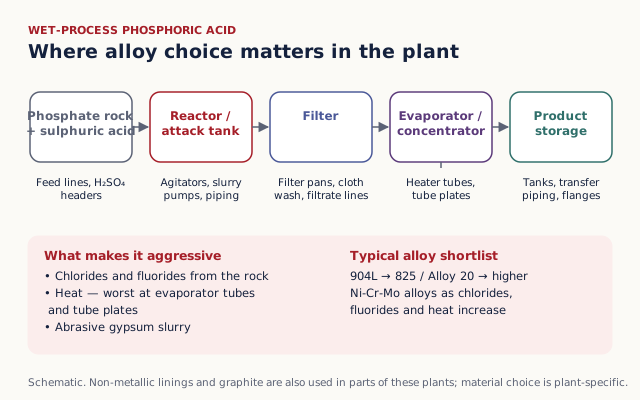
Wet-process phosphoric acid: where the trouble comes from
Pure phosphoric acid is not especially aggressive to these alloys. Wet-process acid is a different matter. Phosphate rock is digested with sulphuric acid, and whatever the rock contains comes along: chlorides, fluorides and silica. Excess sulphuric acid and abrasive gypsum slurry are mixed in as well. Corrosion in a phosphoric plant is therefore driven by three things:
- Chlorides and fluorides. These are the main reason one plant runs happily on 904L while another, using a different rock, needs 825 or better.
- Temperature. The evaporator heaters and their tube plates see the hottest, most concentrated acid. That is why they are usually the most highly alloyed parts of the plant.
- Erosion. Agitators, slurry pumps and the piping around the reactor and filter lose metal to abrasion as well as corrosion. Lower-alloy materials suffer most where the flow is fast.
A typical pattern, which every plant adjusts to its own data: 904L for filter equipment, transfer piping and many tanks; 825 or Alloy 20 where chlorides, fluorides or temperature push past what 904L can take. Non-metallic linings and graphite are used in some of the most severe heat-exchange duty, and those choices belong to the plant licensor.
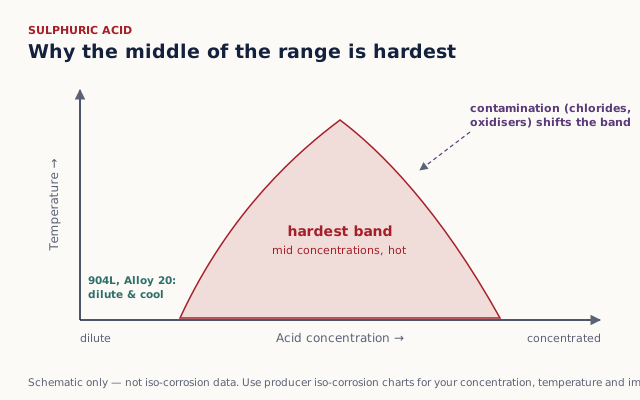
Sulphuric acid in brief
Sulphuric acid behaves differently across its range. Very dilute acid is reducing but weak. Strong acid at low temperature is handled by surprisingly ordinary materials, such as carbon steel at low velocity. The difficult part is the middle concentrations, especially when hot. That is where 904L, Alloy 20 and 825 are compared most often.
Contamination moves the picture in both directions. Oxidising species such as ferric ions or dissolved oxygen can actually help stainless steels and these alloys stay passive. Chlorides make things worse for all of them. That is why we ask for the impurity levels, not just the acid strength, before recommending a grade. Use the producers’ iso-corrosion charts for real numbers; the sketch above shows the shape of the problem, not data.
904L vs 825 vs Alloy 20, side by side
| Factor | SS 904L | Alloy 20 | Alloy 825 |
|---|---|---|---|
| Base | Iron (super-austenitic stainless) | Nickel–iron | Nickel–iron |
| Relative nickel content | Lowest of the three | Middle | Highest of the three |
| Stabilised against intergranular attack by | Very low carbon | Niobium | Titanium |
| Margin against chloride SCC | Better than 316L | High | High |
| Typical relative cost | Lowest | Higher | Higher |
| Availability across forms | Wide: sheet, plate, coil, pipe, fittings, flanges, fasteners | Narrower; confirm form and size | Wide: plate, pipe, fittings, flanges, bar |
| Usual welding filler | ER385 (or over-alloyed Ni-base) | ER320LR | ERNiCrMo-3 |
| Flanges & forgings | ASTM A182 F904L | ASTM B462 | ASTM B564 N08825 |
| Plate | ASTM A240 N08904 | ASTM B463 | ASTM B424 |
| Pipe | ASTM A312 N08904 | ASTM B464 / B729 | ASTM B423 / B705 |
| Buttweld fittings | ASTM A403 WP904L | ASTM B366 WP20CB | ASTM B366 WPNICMC |
904L plate and pipe were also covered by ASTM B625 and B677 in earlier editions; many older drawings still quote them. We supply 904L and 825 across all forms. For Alloy 20, send the enquiry and we will confirm availability for your size.
904L flanges and fasteners in phosphoric acid service
This is one of the most searched questions on our site, and with reason. Flanged joints are where acid finds crevices, and bolting is where buyers cut corners.
Flanges. 904L flanges are forged to ASTM A182 F904L, with dimensions to ASME B16.5. Weld neck flanges are preferred in acid lines because the butt weld leaves no crevice on the bore side. Match the bore to the pipe schedule, specify the gasket (PTFE-based gaskets are common in phosphoric service) and ask for the heat number on every piece. See 904L flanges.
Fasteners. 904L studs, bolts and nuts are usually made from 904L bar to the purchaser’s specification. ASTM A193 and A194 do not list a 904L grade, so state the bar specification, condition and any strength requirement on the PO. Before ordering, check three things:
- Strength: annealed 904L is much weaker than B7 or strain-hardened B8M Class 2 bolting. Confirm the flange design and gasket seating load work with it, or specify a strain-hardened condition with tested properties.
- Galling: austenitic threads gall easily. Use a compatible anti-seize, or PTFE-coated studs, and controlled tightening.
- Matching material: bolting of a lower alloy than the flange may corrode first where it is wetted by drips and leaks. Plant practice varies, so follow your specification.
Product pages: 904L fasteners · stud bolts · heavy hex nuts · 825 fasteners.
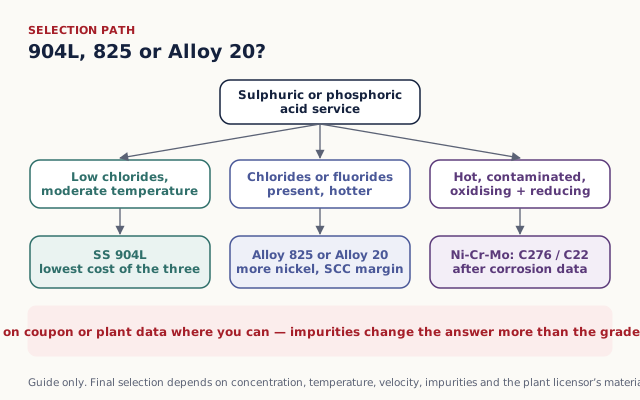
Tube plates in acid coolers and evaporators
Heat exchangers are often the first equipment to show trouble, because metal temperature at the tube wall is higher than the bulk fluid. Tube plates (tubesheets) for 904L exchangers are cut from 904L plate to A240. For thick or large tube plates, 904L-clad carbon steel saves a lot of alloy. Where 904L is not enough, 825 tube plates follow the same pattern. Our tubesheet and tube plate guide explains solid versus clad construction.
Fertilizer and phosphate plants in the Gulf
Saudi Arabia’s phosphate and fertilizer industry, along with sulphuric acid units across the GCC, is a major user of 904L and 825. That covers sheet and plate for vessels and tanks, pipe and fittings for acid transfer, and flanges and fasteners for every joint. We export to Saudi Arabia, Oman and the UAE, with EN 10204 3.1 certificates and third-party 3.2 inspection when the PO asks for it.
What to send with your enquiry
- 01The acid and its concentration range, including upsets.
- 02Operating and maximum metal temperature.
- 03Chloride and fluoride levels, and any oxidisers present.
- 04Velocity or slurry content, if any.
- 05Forms, sizes, standards and the certificate type you need.
With that, we can quote the alloy the conditions need, rather than the one that happens to be cheapest.