Alloy 825 Flanges: ASTM B564, ASME B16.5 and B16.47 Explained

On this page
Alloy 825 flanges — B564 orientation
Alloy 825 flanges — B564 orientationDiagram introducing Alloy 825 flange material and dimensional standards. FLANGES · B564 Forgings & facing ASTM B564 · ASME B16.5 · ASME B16.47 · RF / FF / RTJ

When specifying Alloy 825 flanges, writing only "Incoloy 825 flange" is rarely enough for a technically complete purchase requirement.

A proper flange specification normally needs to identify the alloy, material specification, flange type, dimensional standard, nominal pipe size, pressure class, facing, bore or pipe connection requirements, and the applicable inspection and documentation requirements.

For Alloy 825, buyers may encounter:

  • Alloy 825
  • INCOLOY® Alloy 825
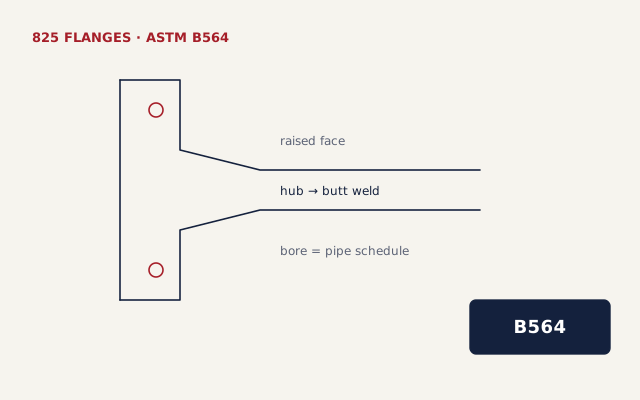
  • UNS N08825
  • W.Nr. 2.4858
  • Incoloy 825
  • the commonly encountered market/search term "Inconel 825"

For procurement, Alloy 825 / UNS N08825 together with the applicable material and dimensional standards provides much clearer identification than relying on a commercial alloy name alone.

The principal standards encountered when specifying Alloy 825 flanges include:

  • ASTM B564/B564M — nickel-alloy forgings, including UNS N08825
  • ASME SB-564 — the corresponding ASME material specification reference where applicable
  • ASME B16.5 — pipe flanges and flanged fittings, NPS 1/2 through NPS 24
  • ASME B16.47 — large-diameter flanges, NPS 26 through NPS 60
  • Other standards may apply depending on the flange type, service, equipment and project specification.

The key principle is simple:

ASTM B564, ASME B16.5 and ASME B16.47 do different jobs.

Understanding that distinction makes an Alloy 825 flange RFQ much easier to prepare and review.


1. What Is Alloy 825?

Alloy 825 is a nickel-iron-chromium alloy with molybdenum, copper and titanium additions.

It is commonly identified as:

  • Alloy 825
  • INCOLOY® Alloy 825
  • UNS N08825
  • W.Nr. 2.4858

For international procurement, UNS N08825 is particularly useful because it provides an unambiguous material identifier alongside the commercial alloy name.

The term "Inconel 825" is also encountered in commercial searches, supplier catalogues and informal RFQs. For a purchase order or technical specification, however, it is preferable to identify the material using Alloy 825 / UNS N08825 and then state the applicable product specification.

The material designation and the flange dimensional standard should be specified separately.


2. Which Standard Covers Alloy 825 Flanges?

Flange anatomy — specification cues
Flange anatomy — specification cuesSchematic flange face with labels for bolt circle, bore, and facing types. Bolt circle / bolt holes Bore / pipe connection Facing (RF / FF / RTJ) Anatomy labels only — NPS, class, and facing must come from the dimensional standard and purchase order, not from this diagram.

ASTM B564/B564M

ASTM B564/B564M is the key material specification to understand for nickel-alloy forgings used in products such as forged flanges.

The current ASTM listing identifies ASTM B564-25 as an active edition of:

Standard Specification for Nickel Alloy Forgings

Its scope includes UNS N08825 under the nickel-iron-chromium-molybdenum-copper alloy group.

Therefore, an Alloy 825 forged flange may be specified using a requirement such as:

Alloy 825 / UNS N08825 ASTM B564

or, within an applicable ASME code framework:

ASME SB-564 / UNS N08825

The exact edition and governing code requirements should always be confirmed against the purchaser's specification.

B564 is the material specification — not the flange dimensional standard

This distinction is critical.

ASTM B564 addresses the forging material/product requirements.

It does not replace the flange dimensional standard.

For example:

ASTM B564 + ASME B16.5

can identify an Alloy 825 forged flange material together with the applicable B16.5 flange dimensions, ratings and related requirements.

Likewise:

ASTM B564 + ASME B16.47

may be relevant for a large-diameter flange within the B16.47 scope.


3. ASTM B564 vs ASME B16.5 vs ASME B16.47

A practical way to understand the standards is:

StandardPrimary roleTypical Alloy 825 relevance
ASTM B564/B564MNickel-alloy forgings material specificationAlloy 825 / UNS N08825 forging material
ASME SB-564ASME material specification referenceAlloy 825 material requirements where applicable
ASME B16.5Pipe flanges and flanged fittingsNPS 1/2 through NPS 24
ASME B16.47Large-diameter flangesNPS 26 through NPS 60
ASME B16.48Line blanksApplicable line-blank requirements rather than ordinary flange selection
Applicable project/code requirementsDesign, fabrication, inspection and service requirementsDepends on the equipment and project

The important procurement principle is:

Material specification + flange dimensional/rating standard + flange configuration

rather than treating all three as interchangeable.

ASME's B16 committee is responsible for standards covering valves, flanges, fittings, gaskets and related pressure-service components. ASME currently lists B16.5-2025 and B16.47-2025 among its recently revised standards.


4. Alloy 825 Flanges — ASME B16.5

ASME B16.5 is the principal dimensional and rating standard encountered for pipe flanges and flanged fittings within its size range.

The current edition listed by ASME is:

ASME B16.5-2025

The standard covers pipe flanges and flanged fittings from NPS 1/2 through NPS 24 and addresses matters including:

  • pressure-temperature ratings
  • materials
  • dimensions
  • tolerances
  • marking
  • testing
  • designation of openings
  • flange bolting
  • gaskets and flange joints within the standard's scope.

This means a specification such as:

Alloy 825 / UNS N08825 ASTM B564 ASME B16.5

is much more informative than simply:

Incoloy 825 flange

The material specification identifies the forging material requirement, while B16.5 establishes the applicable flange standard.


5. Alloy 825 Large-Diameter Flanges — ASME B16.47

For larger nominal pipe sizes, ASME B16.47 becomes important.

The current ASME listing identifies:

ASME B16.47-2025

as the standard for:

Large Diameter Steel Flanges: NPS 26 through NPS 60

The standard covers pressure-temperature ratings, materials, dimensions, tolerances, marking and testing for pipe flanges in the NPS 26–60 range. It includes rating classes 75, 150, 300, 400, 600 and 900 and is limited to flanges made from cast or forged materials, with blind flanges also permitted from plate materials within its scope.

For an Alloy 825 flange RFQ within this size range, the buyer should therefore establish whether the project calls for:

ASTM B564 + ASME B16.47

or another applicable material and dimensional combination.

Do not assume that B16.5 and B16.47 are interchangeable simply because both describe flanges.


6. B16.5 vs B16.47: What Is the Difference?

The simplest distinction is based on the nominal size range.

ASME B16.5

Primarily covers:

NPS 1/2 through NPS 24

ASME B16.47

Covers:

NPS 26 through NPS 60

However, flange selection is not determined by size alone.

The purchaser also needs to confirm:

  • applicable rating class
  • flange type
  • facing
  • material
  • pipe connection
  • governing piping/equipment code
  • project specification
  • applicable edition

For large-diameter projects, the exact B16.47 requirements and series specified by the project should be confirmed rather than inferred from a generic catalogue description.


7. What Is the Material Standard for an Alloy 825 Flange?

For a forged Alloy 825 flange, the material requirement may be stated as:

ASTM B564 / UNS N08825

or within an ASME specification framework:

ASME SB-564 / UNS N08825

ASTM B564-25 explicitly includes UNS N08825 within its scope of nickel-alloy forgings.

This is different from:

ASME B16.5

which defines the applicable flange dimensional, rating and related requirements.

Therefore:

B564 = material/forging specification

B16.5 = flange standard

B16.47 = large-diameter flange standard

This distinction should remain clear throughout the RFQ.


8. ASTM B564 and ASME SB-564

International and code-controlled procurement may use both ASTM and ASME terminology.

You may encounter:

ASTM B564

and:

ASME SB-564

These references relate to the nickel-alloy forging material specification used within their respective standards frameworks.

For an ordinary commercial RFQ, the purchaser should follow the specification named in the project documentation.

For pressure equipment or code-controlled procurement, the applicable construction code and specified edition should govern.

Do not automatically replace an ASTM designation with an ASME designation, or vice versa, without confirming the applicable project requirements.


9. Common Alloy 825 Flange Types

Depending on the applicable dimensional standard and project design, Alloy 825 flanges may be encountered in configurations such as:

  • Weld neck flanges
  • Slip-on flanges
  • Blind flanges
  • Socket-welding flanges
  • Threaded flanges
  • Lap-joint flanges
  • Ring-type joint configurations
  • Other applicable flange configurations

The exact flange type matters because the geometry, connection method and dimensional requirements differ.

For example, a weld neck flange should not be specified simply as an "Alloy 825 flange."

A better RFQ identifies:

Alloy 825 / UNS N08825 ASTM B564 Weld neck flange ASME B16.5 NPS [size] Class [rating] Facing [RF/RTJ/etc.]

The exact requirements should be determined from the project design.


10. Flange Facing: RF, FF and RTJ

Flange facing is another requirement that should not be omitted from a technical RFQ.

B564 with B16.5 / B16.47 map
B564 with B16.5 / B16.47 mapStandards map for Alloy 825 flanges material specification versus dimensional standards and facing. ASTM B564 / B564M Material / forgings ASME B16.5 NPS 1/2–24 (typical scope) ASME B16.47 Large-diameter flanges Facing RF · FF · RTJ B564 identifies the forging/material requirements. B16.5 / B16.47 define dimensional geometry for the stated NPS ranges — specify both where applicable.

Depending on the applicable flange standard and project design, buyers may encounter:

Raised Face — RF

A raised sealing surface around the flange bore.

Flat Face — FF

A flat flange facing configuration.

Ring-Type Joint — RTJ

A flange configuration designed for a metallic ring gasket arrangement within its applicable standard and rating.

The purchaser should specify the required facing rather than leaving the supplier to infer it.

The correct facing depends on the mating flange, gasket system, pressure class, piping design and governing project requirements.


11. Pressure Class Is Not the Same as Material Grade

This is one of the most important concepts when ordering Alloy 825 flanges.

Consider:

Alloy 825 / UNS N08825

This identifies the material.

Whereas:

Class 150 / 300 / 600 / 900 / 1500 / 2500

can identify a flange rating class where applicable under the relevant standard.

These are not interchangeable concepts.

For example:

UNS N08825 + ASME B16.5 Class 600

contains two different pieces of information:

  • UNS N08825 → material identity
  • Class 600 → flange rating designation under the applicable standard

The actual allowable pressure-temperature relationship must be established from the applicable standard and material requirements.

Do not treat the class number as a universal pressure value.


12. Do Not Copy Generic Pressure Tables Into an RFQ

Online Alloy 825 flange pages often publish large tables of:

  • pressure ratings
  • temperatures
  • flange dimensions
  • bolt sizes
  • bore dimensions
  • tolerances

These can be useful for reference, but a project RFQ should not simply copy an internet table.

The applicable rating depends on:

  • flange standard
  • material
  • rating class
  • temperature
  • flange type
  • applicable code
  • design conditions
  • governing project requirements

ASME B16.5 specifically addresses pressure-temperature ratings and materials within its scope.

For procurement, use the applicable standard and project documentation rather than relying on an unverified third-party table.


13. Alloy 825 Flange Dimensions

A flange RFQ may require dimensional information such as:

  • NPS
  • flange outside diameter
  • bore
  • flange thickness
  • bolt circle
  • number of bolt holes
  • bolt-hole diameter
  • hub dimensions where applicable
  • facing dimensions
  • pipe connection dimensions

However, the supplier should normally work from the applicable dimensional standard and project requirement.

For B16.5 applications, the relevant dimensions are governed by the applicable B16.5 requirements.

For B16.47 applications, the large-diameter flange dimensions are governed by B16.47.

Do not mix B16.5 and B16.47 dimensional tables.


14. Alloy 825 Flanges and Manufacturing Route

A flange specification should distinguish between the material specification and the manufacturing/product route.

ASTM B564 is a forging specification.

That does not mean every component described commercially as an "Alloy 825 flange" can automatically be treated as an ASTM B564 forging.

The purchaser should establish:

1. What product is required? 2. What material specification applies? 3. What manufacturing route is permitted? 4. What flange dimensional standard applies? 5. What inspection and documentation are required?

For a forged Alloy 825 flange, an RFQ may identify:

Material: Alloy 825 / UNS N08825 Material specification: ASTM B564 Flange standard: ASME B16.5 Flange type: Weld Neck Size: NPS [XX] Class: [XX] Facing: [RF/RTJ/etc.]

The exact requirements should follow the purchase specification.


15. What Is the Difference Between B564 and B16.5?

This question is common because both standards appear together on flange documents.

ASTM B564

Primarily addresses the nickel-alloy forging material/product requirements.

ASME B16.5

Primarily addresses pipe flange and flanged fitting requirements, including dimensions, ratings, tolerances, marking and testing within its scope.

Therefore:

B564 does not replace B16.5.

And:

B16.5 does not replace B564.

They can work together in a material + dimensional specification.


16. What Is the Difference Between B564 and B16.47?

The same principle applies.

ASTM B564

Material/forging specification.

ASME B16.47

Large-diameter flange standard for NPS 26 through NPS 60.

An Alloy 825 large-diameter flange may therefore require both:

Material specification

and

dimensional/rating standard

rather than selecting one instead of the other.

ASME's current B16.47-2025 description confirms its NPS 26–60 scope and its coverage of pressure-temperature ratings, materials, dimensions, tolerances, marking and testing.


17. What Should an Alloy 825 Flange RFQ Contain?

A useful RFQ should separate the technical requirements into clear fields.

For example:

Material: Alloy 825 / UNS N08825 Material specification: ASTM B564/B564M Flange type: Weld Neck Dimensional standard: ASME B16.5 Nominal size: NPS [XX] Rating class: Class [XX] Facing: RF / FF / RTJ as required Bore: [project requirement] Quantity: [XX Nos.] Inspection: As specified by project Documentation: MTC / applicable certification Marking: As required by applicable standard Additional requirements: [PMI / NDE / TPI / special requirements where specified]

For large-diameter applications, the dimensional standard may instead be:

ASME B16.47

where applicable.


18. What Documentation Should Buyers Request?

The documentation package should be defined by the purchase order and project specification.

Possible documentation may include:

  • Material Test Certificate
  • Heat/lot identification
  • Chemical analysis
  • Mechanical test results
  • Heat-treatment information where applicable
  • Dimensional inspection records
  • Visual inspection records
  • PMI where specifically required
  • NDE reports where specifically required
  • Third-party inspection documentation where specified
  • EN 10204 documentation where required by the purchaser

Do not assume that every Alloy 825 flange automatically includes every possible inspection report.

For example, PMI, radiography, ultrasonic examination or third-party inspection should be stated when required by the project.


19. Does ASTM B564 Automatically Mean Every Flange Has the Same Testing Package?

No.

ASTM B564 establishes requirements for nickel-alloy forgings, but a project's complete inspection package can include additional requirements.

The applicable purchase order may specify:

  • additional examination
  • dimensional inspection
  • PMI
  • third-party inspection
  • documentation requirements
  • supplementary testing

These requirements should be confirmed before ordering.

Avoid treating a supplier's standard inspection package as a universal requirement of ASTM B564.


20. Alloy 825 Flanges for International Procurement

The technical principles remain the same for international buyers.

A project in:

  • Brazil
  • Argentina
  • Chile
  • Colombia
  • Peru
  • UAE
  • Saudi Arabia
  • Oman
  • Southeast Asia
  • India

may use different commercial shipping and documentation requirements, but the technical RFQ still needs to identify the material and applicable flange standard.

For an export enquiry, it can be useful to separate:

Technical requirement

Alloy 825 / UNS N08825 ASTM B564 ASME B16.5 Weld Neck NPS [XX] Class [XX] Facing [XX]

from:

Commercial requirement

Destination: [country/port] Incoterm: FOB Mumbai/Nhava Sheva or agreed alternative Quantity: [XX] Packing: [project requirement] Documentation: [required package]

The commercial destination should not substitute for the technical specification.


21. Common Alloy 825 Flange RFQ Mistakes

Mistake 1: Writing only "Inconel 825 flange"

This leaves important procurement details undefined.

Better: Alloy 825 / UNS N08825 + applicable material specification + flange standard + size + class + facing.


Mistake 2: Writing B16.5 without specifying the material

B16.5 does not tell the supplier that Alloy 825 is required.

Better: State the material specification separately.


Mistake 3: Treating B564 as the flange dimensional standard

B564 is a nickel-alloy forging specification.

B16.5 or B16.47 may establish the applicable flange dimensional/rating requirements.


Mistake 4: Using B16.5 for every flange size

B16.5 and B16.47 have different scopes.

B16.5 covers NPS 1/2 through NPS 24.

B16.47 covers NPS 26 through NPS 60.

Always confirm the applicable standard.


Mistake 5: Omitting the flange class

A flange requirement without the applicable rating class may be incomplete.


Mistake 6: Omitting the facing

RF, FF and RTJ configurations can have different mating and gasket requirements.


Mistake 7: Copying an online pressure table

Do not substitute an unverified online table for the applicable ASME standard and project design.


Mistake 8: Assuming all inspection is automatic

PMI, NDE, TPI and additional documentation should be specified where required.


22. Practical Alloy 825 Flange RFQ Example

A buyer requiring a weld-neck flange could structure the requirement as:

Product: Alloy 825 Weld Neck Flange Material: Alloy 825 / UNS N08825 Material specification: ASTM B564/B564M Dimensional standard: ASME B16.5 Size: NPS [XX] Class: [XX] Facing: Raised Face / Ring-Type Joint as required Bore: [Project requirement] Quantity: [XX Nos.] Inspection: As per purchase specification Documentation: MTC and applicable inspection documentation Marking: As required by applicable standard Additional requirements: [PMI / NDE / TPI where required]

For a large-diameter requirement, the dimensional standard should be reviewed for applicability of:

ASME B16.47

rather than automatically specifying B16.5.


23. B16.5 and B16.47: What Buyers Should Check

Before selecting the flange standard, confirm:

Size

Is the requirement within:

NPS 1/2–24

or:

NPS 26–60?

Material

Is the required material:

Alloy 825 / UNS N08825?

Material specification

Is the requirement:

ASTM B564 / ASME SB-564

or another project-specified material route?

Flange configuration

Is it:

  • Weld neck?
  • Blind?
  • Slip-on?
  • Socket-welding?
  • Threaded?
  • Lap-joint?
  • Another applicable configuration?

Rating

What rating class applies?

Facing

RF / FF / RTJ or another specified configuration?

Governing code

Which piping, pressure equipment or project code applies?

Documentation

What inspection and certification package is required?

This checklist prevents many avoidable RFQ ambiguities.


24. Current Edition References

Standards are periodically revised, so buyers should always verify the edition named by the project.

At the time of preparing this guide:

  • ASTM B564-25 is listed by ASTM as an active edition of the Standard Specification for Nickel Alloy Forgings and includes UNS N08825.
  • ASME B16.5-2025 is listed by ASME for Pipe Flanges and Flanged Fittings, NPS 1/2 through NPS 24.
  • ASME B16.47-2025 is listed by ASME for Large Diameter Steel Flanges, NPS 26 through NPS 60.

The newest listed edition should not automatically be substituted for an edition explicitly named in an existing purchase order, engineering specification or governing code.

Always confirm the applicable edition before procurement.


25. The Short Version: Which Standard Do I Need?

If you remember only the core distinction from this guide:

ASTM B564/B564M

→ Nickel-alloy forging material specification, including UNS N08825.

ASME SB-564

→ ASME material specification reference where applicable.

ASME B16.5

→ Pipe flanges and flanged fittings within its NPS 1/2–24 scope.

ASME B16.47

→ Large-diameter flanges within its NPS 26–60 scope.

The material specification and flange dimensional/rating standard should be specified together where applicable.

So instead of:

"Inconel 825 flange"

a more useful requirement would be:

Alloy 825 / UNS N08825, ASTM B564, ASME B16.5, Weld Neck Flange, NPS [XX], Class [XX], [Facing].

That gives the supplier substantially more information about what the buyer actually needs.


26. Frequently Asked Questions

What ASTM standard covers Alloy 825 flanges?

ASTM B564/B564M is the key nickel-alloy forging specification encountered for forged Alloy 825 flange material. ASTM's current B564-25 listing includes UNS N08825.

What is ASME B16.5 used for?

ASME B16.5 covers pipe flanges and flanged fittings from NPS 1/2 through NPS 24 and addresses pressure-temperature ratings, materials, dimensions, tolerances, marking, testing and related requirements within its scope.

What is ASME B16.47 used for?

ASME B16.47 covers large-diameter pipe flanges from NPS 26 through NPS 60. The current ASME listing is B16.47-2025.

Is ASTM B564 the same as ASME B16.5?

No. ASTM B564 is a nickel-alloy forging material specification, while ASME B16.5 is a flange/flanged-fitting standard covering dimensions, ratings and related requirements within its scope.

Can Alloy 825 flanges be specified as B564 + B16.5?

Yes, where the product, material route and project requirements call for a B564 nickel-alloy forging together with the applicable B16.5 flange requirements.

What is UNS N08825?

UNS N08825 is the Unified Numbering System designation for Alloy 825.

Is "Inconel 825" the official procurement name?

"Inconel 825" is encountered as a commercial/search term. For procurement clarity, identify the material as Alloy 825 / UNS N08825 and specify the applicable material standard.

What flange types are available in Alloy 825?

Depending on the applicable standard and project, buyers may encounter weld neck, slip-on, blind, socket-welding, threaded and lap-joint configurations, among others.

What information should an Alloy 825 flange RFQ contain?

At minimum, identify the alloy/UNS designation, material specification, flange type, dimensional standard, NPS, rating class, facing and quantity. Add bore, inspection, documentation and project-specific requirements where applicable.

Does every Alloy 825 flange require PMI and third-party inspection?

No. Those requirements depend on the purchase order, project specification and applicable inspection plan.


27. Final Alloy 825 Flange Buyer Checklist

Before sending an RFQ, confirm:

Material

  • Alloy 825
  • UNS N08825
  • W.Nr. 2.4858 where required

Material specification

  • ASTM B564/B564M
  • ASME SB-564 where applicable
  • Applicable edition confirmed

Flange

  • Weld neck
  • Blind
  • Slip-on
  • Socket-welding
  • Threaded
  • Lap joint
  • Other required configuration

Dimensional standard

  • ASME B16.5
  • ASME B16.47 where applicable
  • Other project-specified standard where required

Size

  • NPS
  • Bore
  • Pipe schedule/wall requirement where applicable

Rating

  • Required class confirmed

Facing

  • RF
  • FF
  • RTJ
  • Other specified configuration

Quality/documentation

  • MTC
  • Heat/lot traceability
  • PMI if required
  • NDE if required
  • TPI if required
  • EN 10204 documentation if required
  • Project-specific inspection requirements

Commercial

  • Quantity
  • Destination
  • Incoterm
  • Packing
  • Delivery requirement

Need an Alloy 825 Flange Quote?

For an Alloy 825 flange enquiry, provide the UNS designation, flange type, material specification, dimensional standard, NPS, rating class, facing and required documentation.

See the Alloy 825 Flanges product page for the commercial product scope, or use the Alloy 825 RFQ route for a project-specific requirement.

For the broader Alloy 825 standards framework, read:

Standards editions and project requirements can change. Always confirm the applicable edition, material route, flange standard and purchaser specification before placing an order.