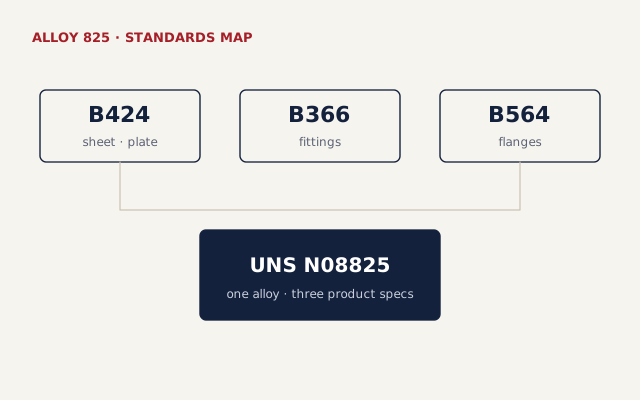
When buying Alloy 825 sheet, plate, fittings or flanges, specifying only "Inconel 825" or "Incoloy 825" is usually not enough for a technically complete RFQ.
Buyers, engineers and procurement teams may encounter several names for the alloy in supplier catalogues and search results, including:
- Alloy 825
- INCOLOY® Alloy 825
- Incoloy 825
- Inconel 825
- UNS N08825
- W.Nr. 2.4858
For procurement, the clearer approach is to identify the material as Alloy 825 / UNS N08825, then specify the applicable product form and material specification, followed by the relevant dimensional or component standard where applicable.
For Alloy 825, commonly encountered specifications and standards include:
- ASTM B424 — plate, sheet and strip
- ASTM B366/B366M — wrought nickel and nickel-alloy fittings
- ASTM B564 — nickel-alloy forgings
- ASME B16.5 — pipe flanges and flanged fittings
- ASME B16.9 — factory-made wrought buttwelding fittings
- ASME B16.11 — forged socket-welding and threaded fittings
- ASME B16.47 — large-diameter flanges
The important point is that these standards do different jobs.
A material specification, product form, dimensional/component standard and project requirement are separate layers of an RFQ.
This guide explains how those layers fit together and how to specify Alloy 825 more clearly.
Quick Alloy 825 specification guide
| Product | Material identification | Common material specification | Common dimensional/component standard |
|---|---|---|---|
| Alloy 825 Sheet | Alloy 825 / UNS N08825 | ASTM B424 | As required by product specification |
| Alloy 825 Plate | Alloy 825 / UNS N08825 | ASTM B424 | As required by product specification |
| Alloy 825 Strip | Alloy 825 / UNS N08825 | ASTM B424 | As required by product specification |
| Alloy 825 Butt-Weld Fittings | Alloy 825 / UNS N08825 | ASTM B366/B366M | ASME B16.9, where applicable |
| Alloy 825 Socket-Weld Fittings | Alloy 825 / UNS N08825 | Applicable material specification | ASME B16.11, where applicable |
| Alloy 825 Threaded Fittings | Alloy 825 / UNS N08825 | Applicable material specification | ASME B16.11, where applicable |
| Alloy 825 Flanges | Alloy 825 / UNS N08825 | ASTM B564, where applicable | ASME B16.5, where applicable |
| Large-Diameter Alloy 825 Flanges | Alloy 825 / UNS N08825 | Applicable material specification | ASME B16.47, where applicable |
The exact combination should be confirmed against the applicable standard edition, engineering specification, drawing, piping class and purchase requirements.
What is Alloy 825?
Alloy 825 is a nickel-iron-chromium alloy with additions of molybdenum, copper and titanium.
The alloy is identified by:
- UNS N08825
- W.Nr. 2.4858
- INCOLOY® Alloy 825 in Special Metals' designation
Special Metals identifies INCOLOY® Alloy 825 as UNS N08825 and W.Nr. 2.4858.
For procurement, UNS N08825 is particularly useful because it gives buyers a standardized material identifier independent of the terminology used by an individual supplier.
The alloy is supplied in multiple product forms, and the applicable material specification can change depending on whether the buyer is purchasing sheet, plate, pipe, tube, bar, fittings or forgings.
That is why "Alloy 825" by itself is an alloy identification—not a complete purchase specification.
Is Alloy 825 the same as Incoloy 825?
In technical and commercial searches, buyers may encounter:
- Alloy 825
- Incoloy 825
- INCOLOY® Alloy 825
- UNS N08825
- W.Nr. 2.4858
Special Metals uses the designation INCOLOY® Alloy 825.
The terms "Alloy 825" and "Incoloy 825" are widely encountered in industrial supplier literature and procurement searches.
You may also encounter "Inconel 825" in search results and commercial listings.
For an RFQ, the safest approach is not to rely on the trade/search terminology alone. Instead, identify the intended material as:
Alloy 825 / UNS N08825
and then state the applicable product specification.
This makes quotations easier to compare and reduces ambiguity between supplier catalogues.
For a deeper discussion of the naming issue, see our guide to Inconel 825 vs Incoloy 825 vs Alloy 825.
ASTM vs ASME: What does each standard do?
One of the most common sources of confusion when purchasing Alloy 825 is treating ASTM material specifications and ASME component standards as interchangeable.
They are not.
A useful way to think about an Alloy 825 specification is:
Material → Product Form → Material Specification → Dimensional/Component Standard → Size/Configuration → Project Requirements
For example:
Alloy 825 / UNS N08825 → butt-weld elbow → ASTM B366/B366M → ASME B16.9 → NPS 4 → required wall/schedule → inspection requirements
Each layer answers a different question.
ASTM material and product specifications
ASTM specifications can establish requirements associated with a particular material/product, including applicable requirements for:
- chemical composition
- mechanical properties
- manufacturing
- heat treatment
- testing
- dimensions or tolerances where specified
- marking
- certification requirements where applicable
For Alloy 825, examples include:
- ASTM B424
- ASTM B366/B366M
- ASTM B564
ASME component standards
ASME B16 standards address particular piping components and standardized dimensional, rating or configuration requirements.
Examples include:
- B16.5 — pipe flanges and flanged fittings
- B16.9 — factory-made wrought buttwelding fittings
- B16.11 — forged socket-welding and threaded fittings
- B16.47 — large-diameter flanges
Therefore, an Alloy 825 RFQ may legitimately contain both an ASTM material specification and an ASME component standard.
ASTM B424 for Alloy 825 Sheet, Plate and Strip
ASTM B424 is one of the most important specifications for Alloy 825 sheet and plate procurement.
For a dedicated sheet and plate RFQ guide covering ASTM B424, ASME SB-424 and UNS N08825, see Alloy 825 Sheet & Plate: ASTM B424 / ASME SB-424.
ASTM B424 covers rolled nickel-iron-chromium-molybdenum-copper alloys in plate, sheet and strip form, including UNS N08825.
This makes it relevant when purchasing:
- Alloy 825 sheet
- Alloy 825 plate
- Alloy 825 strip
A buyer should therefore avoid relying only on:
"Inconel 825 sheet"
when preparing a technical RFQ.
A clearer requirement could be:
Alloy 825 / UNS N08825 sheet, ASTM B424, [thickness] × [width] × [length], [quantity], required inspection and certification requirements.
The exact requirements should be adapted to the applicable standard edition and project specification.
What does ASTM B424 tell the buyer?
ASTM B424 establishes the applicable material/product requirements for the covered nickel-iron-chromium-molybdenum-copper alloys.
However, mentioning ASTM B424 does not automatically provide every detail required for a quotation.
A sheet or plate RFQ may also need:
- product form
- thickness
- width
- length
- quantity
- surface/finish requirement
- edge condition
- required condition where applicable
- testing requirements
- inspection requirements
- certification/documentation requirements
- project or end-user requirements
In other words:
ASTM B424 identifies the applicable material/product specification; it does not replace the buyer's complete dimensional and purchasing requirements.
Alloy 825 sheet and plate
If your requirement is specifically for Alloy 825 sheet or plate, see:
These commercial pages should remain focused on product-specific purchasing intent, while this article explains how the standards fit together.
ASTM B366/B366M for Alloy 825 Fittings
For factory-made wrought nickel-alloy fittings, ASTM B366/B366M is an important material/product specification.
It covers factory-made wrought nickel and nickel-alloy fittings within its scope.
Depending on the product and applicable requirements, fittings may include:
- elbows
- bends
- tees
- reducers
- caps
- lap-joint stub ends
- other covered wrought fittings
- threaded fittings
The fitting's connection type, manufacturing route and dimensional/component standard still need to be established separately.
For example:
Alloy 825 / UNS N08825 butt-weld elbow, ASTM B366/B366M, ASME B16.9, NPS 4, required wall/schedule, quantity.
The exact ASTM grade/designation and supplementary requirements should be confirmed against the applicable specification and project documentation rather than assumed from the product name.
WPNICMC and CRNICMC: why buyers may see these terms
Buyers researching nickel-alloy fittings may encounter B366-related grade/designation terminology such as:
- WPNICMC
- CRNICMC
and associated class/designation markings such as:
- S
- W
- WX
- WU
These markings can appear in technical catalogues and supplier documentation for covered nickel and nickel-alloy fittings.
The important procurement point is not to copy a designation from a catalogue without checking the governing specification.
If a project or piping class requires a particular B366 grade/designation, the RFQ should state that requirement explicitly.
For example:
Alloy 825 / UNS N08825 fitting, ASTM B366/B366M, applicable grade/designation, ASME B16.9, NPS [size], [schedule], quantity.
This prevents the supplier from having to infer the required grade or manufacturing route.
ASTM B366 and ASME B16.9: are they the same thing?
No.
This distinction is important when specifying Alloy 825 fittings.
ASTM B366/B366M
This is the material/product specification for covered wrought nickel and nickel-alloy fittings.
ASME B16.9
This is the dimensional/component standard for factory-made wrought buttwelding fittings.
Therefore, a butt-weld Alloy 825 elbow may be specified using both:
ASTM B366/B366M + ASME B16.9
The ASTM specification addresses the material/product requirements.
The ASME standard addresses the applicable butt-welding fitting requirements.
That is why an RFQ saying only:
"Alloy 825 elbow"
leaves important technical information unspecified.
ASME B16.9 for Alloy 825 Butt-Weld Fittings
ASME B16.9 covers factory-made wrought buttwelding fittings.
It is relevant to products such as:
- elbows
- tees
- reducers
- caps
- returns
- other standardized butt-welding fittings within its scope
For an Alloy 825 butt-weld fitting, an RFQ may identify:
Alloy 825 / UNS N08825 > ASTM B366/B366M > ASME B16.9 > NPS [size] > [wall thickness/schedule] > [configuration] > [quantity]
Additional project requirements may include inspection, testing and certification.
The applicable edition should be confirmed from the governing project specification.
ASME B16.11 for Alloy 825 Socket-Weld and Threaded Fittings
ASME B16.11 covers forged fittings for socket-welding and threaded connections.
This is different from a conventional butt-weld fitting.
For this reason, an Alloy 825 fitting RFQ should identify the connection type rather than simply listing B16.9 and B16.11 together.
For example:
Alloy 825 socket-weld fitting → applicable material specification + ASME B16.11
or:
Alloy 825 butt-weld elbow → applicable material specification + ASME B16.9
Why you may see both ASTM B366 and ASTM B564 with B16.11
This is an area where supplier catalogues can create confusion.
Depending on the fitting, manufacturing route and governing project specification, buyers may encounter ASTM B366/B366M + ASME B16.11 as well as ASTM B564 + ASME B16.11 in commercial and technical documentation.
ASTM B366/B366M covers applicable wrought nickel-alloy fittings and includes fittings associated with B16.11 within its scope. ASTM B564 covers nickel-alloy forgings.
Therefore, the RFQ or purchase order should make the required material specification and manufacturing route explicit rather than assuming that one ASTM specification universally applies to every socket-weld or threaded Alloy 825 fitting.
For a project-controlled purchase, the piping class, engineering specification and applicable ASTM/ASME requirements should govern.
MSS standards you may encounter for fittings
Alloy 825 fitting requirements may also reference MSS standards in addition to ASTM and ASME specifications.
Examples that buyers may encounter include:
- MSS SP-43
- MSS SP-95
- MSS SP-97
These standards address particular fitting/component requirements and should not be treated as substitutes for the Alloy 825 material specification.
A complete RFQ should therefore separate:
Material specification + fitting/component standard + dimensions/configuration + project requirements.
If an MSS standard is named in the piping specification, include it explicitly in the RFQ rather than assuming it from the product name.
ASTM B564 for Alloy 825 Forgings and Flanges
ASTM B564 is the ASTM specification for nickel-alloy forgings.
It includes UNS N08825 among its covered nickel-iron-chromium-molybdenum-copper alloy designations.
This can be relevant when an Alloy 825 component is manufactured as a forging and the applicable project specification calls for B564.
For a flange, the requirement should therefore not be reduced to:
"Alloy 825 flange"
Instead, establish:
- material identity
- manufacturing/product specification
- applicable flange dimensional standard
- size
- class/rating
- flange type
- facing
- project requirements
For example:
Alloy 825 / UNS N08825 flange, ASTM B564 where applicable, ASME B16.5, NPS [size], Class [rating], [flange type], [facing].
The exact specification combination must be confirmed against the component design and project requirements.
A note about plate flanges and blind flanges
Not every component that looks like a flange should automatically be assumed to use the same forging specification.
Depending on the component design, manufacturing route and governing project/code requirements, certain plate-based components, including some plate-cut blind flange applications, may follow a different material specification.
Therefore, before placing an order, confirm:
- the flange/component type
- the manufacturing route
- the material specification
- the applicable ASME/MSS/component standard
- the project or piping-class requirement
The supplier should quote against the actual specified manufacturing route rather than selecting a material standard based only on the word "flange."
ASME B16.5 for Alloy 825 Flanges
ASME B16.5 is the major ASME standard buyers encounter for pipe flanges and flanged fittings in the NPS 1/2 through NPS 24 range.
For an Alloy 825 flange, an RFQ may need to identify:
- Alloy 825 / UNS N08825
- applicable material specification
- ASME B16.5
- NPS
- pressure class/rating
- flange type
- facing
- bore where applicable
- quantity
- inspection requirements
- certification/documentation requirements
For example:
Alloy 825 / UNS N08825 flange, applicable ASTM material specification, ASME B16.5, NPS 6, Class [rating], [flange type], [facing], [quantity].
The applicable material specification must be confirmed from the manufacturing route and project requirements.
ASME B16.47 for Large-Diameter Alloy 825 Flanges
For large-diameter flanges, ASME B16.47 becomes relevant.
B16.47 covers large-diameter steel flanges in the NPS 26 through NPS 60 range.
Therefore:
- B16.5 → NPS 1/2 through NPS 24
- B16.47 → NPS 26 through NPS 60
The applicable material specification remains a separate question.
A large-diameter Alloy 825 flange RFQ should therefore identify:
- Alloy 825 / UNS N08825
- applicable material specification
- ASME B16.47
- NPS
- rating/configuration
- facing
- quantity
- inspection and certification requirements
Material specification vs dimensional/component standard
The easiest way to understand the Alloy 825 specification system is to separate the layers.
Sheet and plate
Alloy 825 / UNS N08825
↓
ASTM B424
↓
Dimensions + quantity + condition + inspection + certification
Butt-weld fittings
Alloy 825 / UNS N08825
↓
Applicable material specification such as ASTM B366/B366M
↓
ASME B16.9
↓
NPS + wall/schedule + configuration + quantity + project requirements
Socket-weld or threaded fittings
Alloy 825 / UNS N08825
↓
Applicable material specification
↓
ASME B16.11
↓
Size + class/configuration + connection + quantity + project requirements
Flanges
Alloy 825 / UNS N08825
↓
Applicable material specification
↓
ASME B16.5 or B16.47, as applicable
↓
NPS + class/rating + flange type + facing + project requirements
This layered approach is one of the easiest ways to prevent an incomplete RFQ.
Other Alloy 825 ASTM specifications you may encounter
The three specifications most relevant to this guide are:
- ASTM B424 — plate, sheet and strip
- ASTM B366/B366M — covered wrought fittings
- ASTM B564 — forgings
However, Alloy 825 is available in other product forms.
Depending on what you are purchasing, you may encounter:
- ASTM B425 — nickel-iron-chromium-molybdenum-copper alloy rod and bar
- ASTM B423 — nickel-iron-chromium-molybdenum-copper alloy seamless pipe
- ASTM B163 — seamless nickel and nickel-alloy condenser and heat-exchanger tubes
The correct specification depends on the product form.
This is why searching for "Alloy 825 ASTM" without identifying the product can produce multiple specifications.
What does ASME SB424 or SB366 mean?
Buyers may encounter references such as:
- ASTM B424 / ASME SB424
- ASTM B366 / ASME SB366
- ASTM B564 / ASME SB564
These references should not automatically be treated as interchangeable in every purchasing situation.
For code-related procurement, identify:
- the governing code
- applicable material specification
- applicable edition
- product form
- project requirements
When a quotation states an ASTM/ASME dual designation, verify that it meets the governing project or code requirement.
What should you include in an Alloy 825 sheet or plate RFQ?
For sheet or plate, provide enough information for the supplier to identify the exact requirement.
Recommended RFQ information
- Product form — sheet or plate
- Alloy — Alloy 825
- UNS — N08825
- Material specification — ASTM B424, where applicable
- Thickness
- Width
- Length
- Quantity
- Surface/finish requirement
- Required condition where applicable
- Inspection/testing requirements
- Certification requirements
- Project/end-user specification
Example
Alloy 825 / UNS N08825 plate, ASTM B424, [thickness] × [width] × [length] mm, [quantity], required condition/finish, inspection and certification requirements as per project specification.
For an actual purchase, replace the placeholders with the project requirements.
What should you include in an Alloy 825 fittings RFQ?
For fittings, specify the actual connection and configuration.
Recommended information
- Fitting type
- Alloy 825 / UNS N08825
- Applicable material specification
- Applicable ASME/MSS component standard
- NPS
- Wall thickness/schedule where applicable
- Configuration
- Seamless/welded requirement where applicable
- Class/rating where applicable
- Quantity
- Inspection/testing requirements
- Certification requirements
Example: butt-weld fitting
Alloy 825 / UNS N08825 90° butt-weld elbow, ASTM B366/B366M, ASME B16.9, NPS [size], [schedule/wall], [quantity], inspection and certification requirements as per project specification.
Example: socket-weld fitting
Alloy 825 / UNS N08825 socket-weld fitting, applicable material specification, ASME B16.11, NPS [size], Class [rating], [quantity], inspection and certification requirements as per project specification.
The exact material grade/designation and manufacturing requirements should be confirmed before placing the order.
What should you include in an Alloy 825 flange RFQ?
A flange RFQ should normally identify:
- Alloy 825 / UNS N08825
- Applicable material specification
- ASME B16.5 or B16.47, as applicable
- NPS
- Pressure class/rating
- Flange type
- Facing
- Bore where applicable
- Quantity
- Inspection/testing requirements
- Certification requirements
- Project/end-user specification
Example
Alloy 825 / UNS N08825 flange, applicable ASTM material specification, ASME B16.5, NPS [size], Class [rating], [flange type], [facing], [quantity], inspection and certification requirements as per project specification.
For large-diameter requirements, confirm whether ASME B16.47 applies.
Common Alloy 825 specification mistakes
1. Treating a trade name as a complete specification
"Inconel 825 sheet"
does not communicate the complete purchase requirement.
A clearer RFQ starts with:
Alloy 825 / UNS N08825
and identifies the applicable product specification.
2. Confusing the material standard with the dimensional standard
ASTM B424 and ASME B16.5 do not perform the same function.
The material specification and component/dimensional standard may both appear in the same RFQ because they describe different aspects of the product.
3. Pairing every fitting with the same ASTM specification
Fitting requirements can depend on the product type, manufacturing route and governing project specification.
Do not copy a competitor's "ASTM B366" or "ASTM B564" line into every Alloy 825 fitting RFQ without checking the actual requirement.
4. Treating B16.9 and B16.11 as interchangeable
They address different connection types.
- B16.9 → factory-made wrought buttwelding fittings
- B16.11 → forged socket-welding and threaded fittings
The connection type should be stated.
5. Assuming every Alloy 825 flange uses the same material route
A flange/component requirement should be checked against the actual manufacturing route and governing project specification.
Do not assume that every flange-shaped component automatically requires ASTM B564.
6. Omitting the UNS number, grade, class or dimensions
"Alloy 825 flange" leaves important information unspecified.
Depending on the product, the RFQ may need:
- UNS designation
- ASTM material specification
- ASME/MSS standard
- NPS
- schedule/wall
- class/rating
- facing
- quantity
- inspection requirements
7. Copying a supplier catalogue line without checking the project requirements
Supplier catalogue pages are useful for identifying terminology, but the governing purchase specification should determine what is actually ordered.
A supplier's product title is not a substitute for the engineering specification.
International procurement of Alloy 825
Alloy 825 is purchased internationally, and buyers may encounter different combinations of:
- Alloy 825
- INCOLOY® 825
- Incoloy 825
- Inconel 825
- UNS N08825
- W.Nr. 2.4858
- ASTM specifications
- ASME specifications
- EN references
- project-specific requirements
The most effective way to compare quotations is to normalize them against the actual technical requirement.
For example:
Alloy 825 / UNS N08825 + product form + applicable ASTM specification + applicable ASME/MSS component standard + dimensions + quantity + inspection/certification requirements
For export enquiries from markets such as the Gulf, South America and Southeast Asia, buyers can also state the destination and required shipping/documentation terms in the RFQ.
For Kanak Steel & Engineering Co., international buyers can provide the destination, preferred Incoterm and documentation requirements when requesting a quotation. FOB Mumbai/Nhava Sheva can be discussed where applicable to the shipment.
Commercial terms, freight, insurance, packing and documentation should be confirmed separately from the technical material specification.
MTC, PMI and third-party inspection for Alloy 825
Material certification and inspection requirements should be treated as part of the purchase specification, not assumed simply because the product is described as Alloy 825.
Depending on the project, buyers may request:
- Material Test Certificate
- chemical analysis
- mechanical test results
- heat/lot traceability
- PMI
- dimensional inspection
- third-party inspection
- project-specific testing
- EN 10204 certification where specified
If EN 10204 Type 3.1 or another certification level is required, state it explicitly in the RFQ.
Likewise, if PMI or third-party inspection is required, specify it before quotation.
Do not assume that every supplier quotation includes the same inspection or certification package.
Why UNS N08825 matters in an RFQ
Consider these two requests:
"Need Inconel 825 sheet."
and:
"Need Alloy 825 / UNS N08825 sheet, ASTM B424, [dimensions], [quantity], with required inspection and certification."
The second request gives the supplier a much clearer technical starting point.
The same principle applies to fittings and flanges.
Instead of:
"Need Inconel 825 flanges."
a buyer can identify:
Alloy 825 / UNS N08825 + applicable material specification + ASME B16.5/B16.47 as applicable + NPS + class + flange type + facing + quantity.
The goal is not to make an RFQ unnecessarily complicated.
The goal is to remove ambiguity before quotations are compared.
Alloy 825 specification decision tree
When you receive an Alloy 825 requirement, start with five questions.
1. What alloy?
Alloy 825 / UNS N08825
2. What product form?
- Sheet?
- Plate?
- Strip?
- Fitting?
- Flange?
- Pipe?
- Tube?
- Bar?
3. Which material/product specification applies?
Examples include:
- B424
- B366/B366M
- B564
- B425
- B423
- B163
4. Is a dimensional/component standard required?
Examples include:
- B16.9
- B16.11
- B16.5
- B16.47
- applicable MSS standards
5. What additional purchasing information is required?
Depending on the product:
- dimensions
- NPS
- schedule/wall
- class/rating
- facing
- quantity
- inspection
- testing
- certification
- project/end-user requirements
This five-step approach can prevent many specification errors before an RFQ reaches the supplier.
Frequently Asked Questions
What ASTM specification covers Alloy 825 sheet and plate?
ASTM B424 covers rolled nickel-iron-chromium-molybdenum-copper alloys in plate, sheet and strip form, including UNS N08825.
What ASTM specification covers Alloy 825 fittings?
ASTM B366/B366M covers factory-made wrought nickel and nickel-alloy fittings within its scope. The exact fitting type, material designation and applicable dimensional standard should be confirmed from the project requirements.
What ASTM specification is used for Alloy 825 flanges?
ASTM B564 covers nickel-alloy forgings and includes UNS N08825. Whether B564 is the applicable material specification for a particular flange/component depends on the manufacturing route and governing project requirements.
What is the difference between ASME B16.5, B16.9 and B16.11?
They address different piping components:
- B16.5 — pipe flanges and flanged fittings
- B16.9 — factory-made wrought buttwelding fittings
- B16.11 — forged socket-welding and threaded fittings
Is Inconel 825 the correct name?
"Inconel 825" is encountered as a commercial/search term. For technical procurement, it is preferable to identify the material as Alloy 825 / UNS N08825 and state the applicable product specification.
Is Alloy 825 the same as UNS N08825?
UNS N08825 is the standardized UNS designation associated with Alloy 825. Special Metals identifies INCOLOY® Alloy 825 as UNS N08825 and W.Nr. 2.4858.
Can ASTM and ASME standards appear together in an RFQ?
Yes. They can address different specification layers. For example, an Alloy 825 butt-weld fitting may have an applicable ASTM material specification together with ASME B16.9 requirements.
What should I include in an Alloy 825 RFQ?
At minimum, identify the alloy/material designation, UNS number, product form, applicable material specification, dimensional/component standard where relevant, size/dimensions, quantity and project-specific inspection or certification requirements.
What standard applies to large-diameter Alloy 825 flanges?
ASME B16.47 covers large-diameter flanges in the NPS 26 through NPS 60 range. The applicable Alloy 825 material specification must be established separately.
Need Alloy 825 Sheet, Plate, Fittings or Flanges?
If you are sourcing Alloy 825 / UNS N08825, start with the product form and applicable specification rather than relying only on the commercial alloy name.
Kanak Steel & Engineering Co. handles enquiries for:
For a quotation, provide the product form, material designation, applicable ASTM/ASME specification, dimensions or NPS, quantity and any inspection or certification requirements.
For technically complex requirements, sharing the project specification, drawing or RFQ helps establish the applicable specification before quotation.
Request an Alloy 825 quotation → Request an RFQ
Standards edition note
ASTM and ASME standards are periodically revised. Buyers should confirm the edition specified by the governing project, purchase order, engineering code or end-user requirement.
For this guide, commonly referenced editions include ASTM B424-22, ASTM B366/B366M-25, ASTM B564-25, ASME B16.9-2024, ASME B16.5-2025, ASME B16.47-2025 and ASME B16.11-2021 based on the standards research used during preparation.
The applicable edition for a specific purchase should always be verified against the governing project or code requirement.
This article is intended as a procurement and specification guide. It does not replace the applicable ASTM or ASME standard, engineering specification, drawing, piping class or project requirements.